
Stepping into a Hyrox competition feels electric. Your heart races, the crowd cheers, and every movement counts. Preparing for it is about building strength, endurance, and strategy. If you’re thinking about signing up, you might wonder how people train for something that demands so much from the body. The truth is, anyone can get better at Hyrox with the right structure and a plan that builds you up step by step.
A good Hyrox training plan helps you balance endurance, power, pacing, and recovery so you don’t feel overwhelmed or lost. In this guide, you’ll learn how to train smarter, prepare with confidence, and build the consistency needed to finish strong on race day.
What is a Hyrox Workout?
Hyrox is organized by Hyrox GmbH, a fitness company based in Germany. The company was founded to create a competition that combines running with functional strength challenges in a format accessible to all fitness levels. The first official Hyrox event took place in 2017 in Hamburg, attracting athletes from various backgrounds, including runners, CrossFit participants, and gym enthusiasts.
A Hyrox workout follows a race format that mixes running with eight functional fitness stations. You run 1 km, complete a station, then repeat this pattern until you finish all eight rounds. These 8 stations may include:
- Sled push
- Sled pull
- Rowing
- SkiErg
- Weighted carries (farmer’s carry)
- Sandbag lunges
- Wall balls
This structure creates a steady challenge because your heart rate stays high from the constant movement. Your muscles work hard as you shift between strength and cardio tasks. Many athletes enjoy this format because it feels like a clear test of full-body fitness.
A Hyrox Training Plan prepares you to handle both the running and the station work while staying calm under pressure. The workout looks intense, but the flow stays simple. You run, you complete a task, and you keep going. This rhythm makes Hyrox great for people who like clear, repeatable challenges. It also helps you measure progress because you can track your pace, reps, and time across the entire sequence.
To build a training plan for Hyrox, you need to assess your strengths and weaknesses. A study published by Frontiers in Physiology, showed that participants spent more time running than at the workstations. You can use information like this to create a custom and personal training plan.
What Should Be Included in a Hyrox Training Plan?
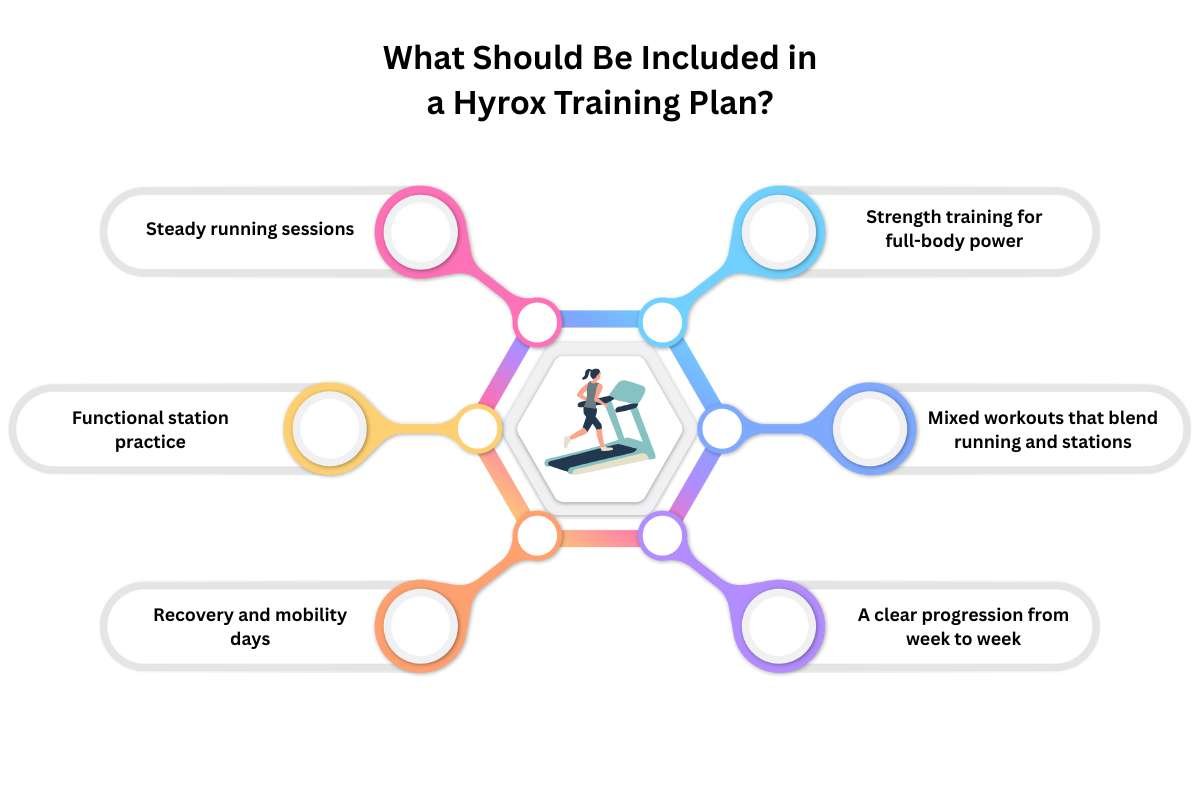
A solid Hyrox Training Plan should build both strength and endurance at the same time. The race uses many movement patterns, so your plan must train your body in different ways. A good plan should mix running, strength work, and skill practice across the week. Here are the key parts you should look for:
1. Steady running sessions
You need strong aerobic fitness because most of the race time comes from running. Your plan should include easy runs, long runs, and interval runs. These runs help you control your pace and stay fresh through all eight rounds.
2. Strength training for full-body power
Hyrox stations hit your legs, core, and upper body. You need sessions that build pushing, pulling, and carrying strength. These moves help you handle sled pushes, sled pulls, and farmer’s carries with better form.
3. Functional station practice
You should train the exact skills you will face on race day. This includes rowing, SkiErg work, wall balls, sandbag lunges, and burpees. Simple practice builds confidence and teaches your body to move well under fatigue.
4. Mixed workouts that blend running and stations
Race-style sessions help you switch between running and strength work without losing control. These workouts teach you how to keep your heart rate steady when your legs feel heavy.
5. Recovery and mobility days
Your plan must include rest, stretching, and slower effort days. These sessions help your muscles recover and protect you from overuse injuries. They also keep your legs and shoulders loose for the next round of training.
6. A clear progression from week to week
A strong Hyrox Training Plan should increase difficulty in small steps. You might add more distance, more reps, or a slightly faster pace. This slow rise in effort helps you grow without burning out.
Here is a 4 Week Hyrox Training Plan for Steady Strength and Endurance
This plan can help you build strength, speed, and steady pacing for race day. Each week adds simple progressions that help your body handle runs and station work.We curated this plan by studying common Hyrox race demands, reviewing athlete training logs, and matching the sessions with the skills needed for each station.
Week 1
Monday — Endurance circuit:
- 400 m SkiErg
- 20 barbell thrusters
- 20 over the bar burpees
- 20 Romanian deadlifts. Repeat 4 rounds.
Duration: 60 mins
Tuesday — 45-minute endurance AMRAP:
- 50 m sled push
- 50 m sled pull
- 50 m run
- 40 wall balls. Repeat for 45 minutes.
Duration: 50-55 mins
Wednesday — Performance mix:

- 500 m run + 30 barbell squats
- 500 m run + 30 barbell rows
- 500 m run + 30 Romanian deadlifts
- 500 m run
- Finish with an AMRAP of unbroken wall balls.
Duration: 60-65 mins
Thursday — Active recovery:
- Easy 5 km run.
Duration: 30-35 mins
Friday — Rest
Saturday — Running intervals:
- 1 km run + equal walk or rest. Repeat 8 rounds.
Duration: 45-50 mins
Sunday — Rest
This first week builds the base layer of your Hyrox Training Plan. Your body learns how to shift between running and strength tasks without stopping. The runs help steady your breathing and improve your pace control. The strength pieces improve your posture and help your muscles handle repeated efforts. You also begin to understand how it feels to work under fatigue, which is a key part of Hyrox. These early sessions give you confidence and help you stay relaxed as intensity builds in the next weeks.
Week 2
Monday — Strength, core, and lower body:
Core:
- 50 plank dips
- 50 jackknives
- 50 Superman holds
Lower body circuit (4 rounds):
- 100 m sandbag walking lunges
- 50 m sled push
- 10 sandbag RDL + clean + squat
Duration: 60-65 mins
Tuesday — Mixed cardio and conditioning:
- 10 minutes alternating between 300 m SkiErg and 300 m bike.
- 10-minute dumbbell circuit and 10-minute kettlebell or dumbbell combo
Duration: 55-60 mins
Wednesday — Upper body, core, and run finisher:
- Core block and Strength block with push presses, rows, and burpees
- 3 x 1 km runs
Duration: 60-65 mins
Thursday — Rest
Friday — Half simulation:

- Four 1 km runs paired with four functional stations.
Duration: 60-65 mins
Saturday — Rest
Sunday — Zone 2 steady run:
- 5 km at a comfortable pace.
Duration: 25-30 mins
Week two increases the work rate and pushes you deeper into real Hyrox-style movement. Your legs learn to stay strong during lunges, sled pushes, and carries. Your grip and core grow steadier, which helps you stay balanced during all stations. The half simulation shows you how fast the race can feel when stations and runs blend together. You also learn how to manage fatigue and how to pace the early stations. All of this prepares you for the heavier weeks ahead in the Hyrox Training Plan.
Week 3 — Deload and Form Week
Monday — Low-intensity full-body session:
- 300 m easy row
- High-rep strength work
- Core finisher
Duration: 50-55 mins
Tuesday — Rest
Wednesday — Repeat Monday session
Duration: 50-55 mins
Thursday — Light mixed session:
- Short SkiErg EMOM Bodyweight circuit.
- Light sled push
Duration: 45 mins
Friday — Rest
Saturday — Running intervals:
- 1 km run + equal rest. Repeat 8 rounds.
Duration: 45-50 mins
Sunday — Light performance session: Repeat Thursday’s structure.
Duration: 45 mins
This week reduces intensity so your body can recover while staying active. The lower load helps your joints and muscles repair after two heavy weeks of the Hyrox Training Plan. You still move enough to keep your heart rate steady, which improves your aerobic base. The lighter circuits give you space to clean up your form, especially during lunges, rows, and burpees. Many athletes notice that their breathing improves during deload weeks because the pressure stays low. When your body feels fresh again, you are ready to handle the final build in week four.
Week 4 — Peak conditioning
Monday — Rest
Tuesday — Full-body interval circuit: 40-second stations of:
- Walking lunges
- Renegade rows
- Front rack squats
- Bent-over rows
- Farmer’s carry
- Dumbbell devil press
- Dumbbell RDL Repeat several rounds.
Duration: 50-55 mins
Wednesday — Rest
Thursday — Repeat Tuesday circuit
Duration: 50-55 mins
Friday — Race simulation: Four final Hyrox-style stations, 4 x 1 km runs at race pace
Duration: 70-75 mins
Saturday — Active recovery:
- Easy 5 km run
Duration: 30-35 mins
Sunday — Rest
This final week increases your conditioning so you can match the effort of a real Hyrox event. The interval circuits raise your heart rate and teach you to keep moving through fatigue. The simulation helps you understand the rhythm of the final stations, which often feel the hardest during an event. You also learn how to push while staying relaxed, which improves your overall pace. By the end of the week, you should feel strong, settled, and ready for a full Hyrox race.
| Day / Week | Week 1 | Week 2 | Week 3 | Week 4 |
| Monday | Endurance circuit | Core + lower body | Low-intensity full-body | Rest |
| Tuesday | 45-min AMRAP | Mixed cardio & circuits | Rest | Full-body interval |
| Wednesday | Performance mix | Upper body & core + run | Repeat Monday | Rest |
| Thursday | Easy 5 km run | Rest | Light performance circuit | Repeat interval |
| Friday | Rest | Half simulation | Rest | Race simulation |
| Saturday | Running intervals | Rest | Running intervals | Easy 5 km run |
| Sunday | Rest | Zone 2 run | Light performance | Rest |
What to Eat During Hyrox Training?
Your food choices support every part of your Hyrox Training Plan. Simple meals work best because your body uses energy fast.
Before training: Eat light, easy carbs and lean protein. Options include oats, toast with eggs, yogurt with fruit, or rice with chicken. These foods give steady energy without slowing digestion.
During long sessions: Drink water often. Add electrolytes during longer workouts. These keep your muscles ready and prevent early fatigue.
After training: Eat a mix of carbs and protein within an hour. Many athletes like rice bowls, yogurt with fruit, or smoothies. These meals help your muscles recover so you feel ready for the next session.
Tips for Hyrox Training
These tips show how real athletes get better without burning out. They focus on practical ways to handle runs, stations, and fatigue. Use them to make each Hyrox session feel more manageable and effective.
- Train regularly and respect rest days so your body stays strong.
- Practice lunges, sleds, carries, and burpees often because these show up in every Hyrox Training Plan.
- Run when tired at least once a week to match real race conditions.
- Keep notes about your pace, reps, and energy levels. Small details help you adjust the plan.
- Test your food and drinks during normal training. Your stomach needs practice just like your muscles.
Conclusion:
Training for Hyrox can feel demanding, but the effort pays off the moment you cross that final finish line. A structured approach keeps you focused, reduces guesswork, and helps you build both strength and endurance. As you follow your Hyrox training plan, every session teaches you how to pace better, stay calm under fatigue, and trust your preparation. With steady progress and smart recovery, the race stops feeling intimidating and starts feeling within reach.
FAQ
1. What workouts should a Hyrox training plan include?
It should mix steady runs, interval training, sled work, wall balls, lunges, rowing, and strength sessions for both upper and lower body.
2. Do I need to be good at running to start Hyrox training?
Not at all. Many beginners improve their running through the plan itself. You only need a basic fitness level to start.
3. Do I need special equipment to train?
Basic gym access is usually enough. You’ll need a sled, rowing machine, wall ball, kettlebells, and space for running or treadmill work.