“In healthcare, every minute saved can change a life.”
Healthcare systems across the world are under growing strain. Studies show that doctors spend nearly 35% of their time on administrative tasks, while patients often wait days or even weeks for test results and appointments. At the same time, global healthcare costs are rising every year, putting pressure on hospitals to deliver better care with limited resources. This is where AI healthcare efficiency is making a measurable difference.
In simple terms, the efficiency of AI in healthcare helps hospitals and doctors work faster, reduce errors, and improve patient outcomes. AI-powered tools can analyze medical images up to 30% faster, automate patient records, and predict health risks before they become serious. These systems are already being used in real hospitals to shorten wait times, improve diagnostic accuracy, and reduce workload for healthcare staff.
Most importantly, AI supports medical professionals. By handling repetitive and time-consuming tasks, AI allows doctors to spend more time with patients and make better-informed decisions. With proven results, growing clinical adoption, and strong data-backed outcomes, AI healthcare efficiency is becoming a trusted solution for building a smarter, safer, and more reliable healthcare system.
In this blog, we’ll break down how AI is improving healthcare efficiency in clear, easy-to-understand ways and why it is shaping the future of modern healthcare.
Understanding AI Healthcare Efficiency in Simple Terms
The efficiency of AI in Healthcare refers to the use of advanced technology to make healthcare processes faster, more accurate, and less error-prone. It helps hospitals and clinics manage large volumes of data, streamline operations, and support doctors in delivering better care.
For example, AI can review thousands of patient records in seconds, highlight critical information, and assist in identifying early signs of diseases such as cancer, heart conditions, or diabetes. Studies show that AI tools can reduce diagnostic time by up to 30% and improve accuracy in imaging and lab tests, which directly impacts patient outcomes.
AI also reduces the burden of repetitive tasks. Administrative work, medical documentation, and appointment scheduling can consume up to 35% of a doctor’s time, according to recent research. By automating these tasks, AI allows healthcare professionals to focus more on patient care, improving efficiency and reducing burnout.
Importantly, AI supports medical staff rather than replacing them. Its role is to provide actionable insights based on large amounts of data, helping doctors make informed decisions while maintaining patient safety. Across hospitals that have implemented AI, measurable benefits include faster workflows, fewer errors, and improved overall care delivery.
AI healthcare efficiency is proving to be a practical, reliable solution for healthcare systems facing rising costs, growing patient loads, and increasing demand for faster, safer care.
The Current Challenges Holding Healthcare Systems Back
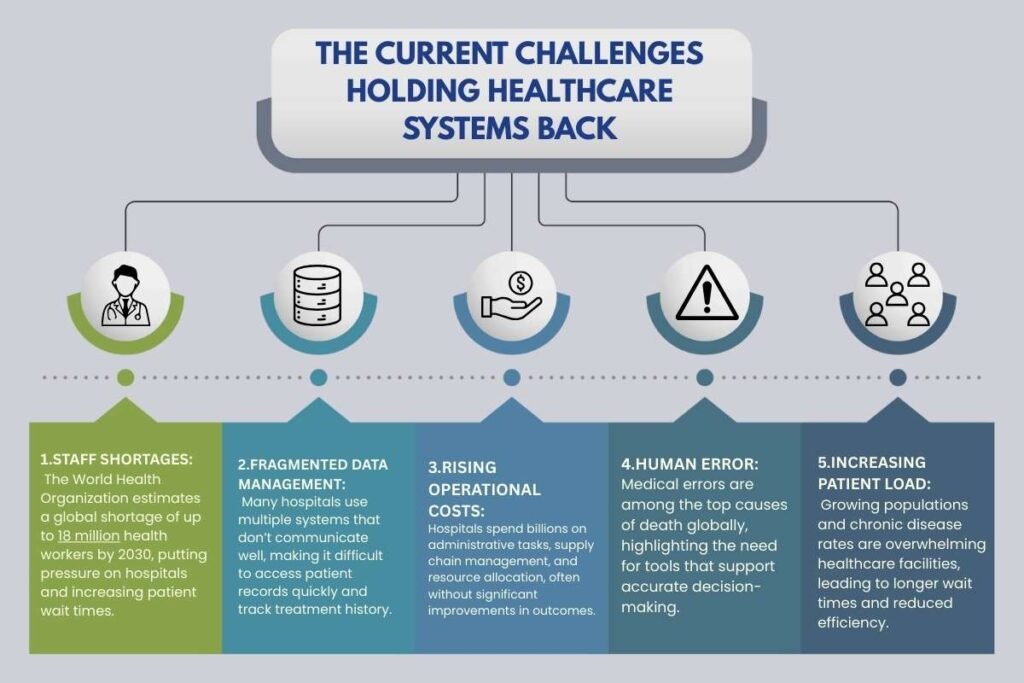
Healthcare systems face several major challenges that limit efficiency and affect patient care:
- Staff Shortages: The World Health Organization estimates a global shortage of up to 18 million health workers by 2030, putting pressure on hospitals and increasing patient wait times.
- Fragmented Data Management: Many hospitals use multiple systems that don’t communicate well, making it difficult to access patient records quickly and track treatment history.
- Rising Operational Costs: Hospitals spend billions on administrative tasks, supply chain management, and resource allocation, often without significant improvements in outcomes.
- Human Error: Medical errors are among the top causes of death globally, highlighting the need for tools that support accurate decision-making.
- Increasing Patient Load: Growing populations and chronic disease rates are overwhelming healthcare facilities, leading to longer wait times and reduced efficiency.
These challenges highlight why improving efficiency is essential. The efficiency of AI in healthcare helps address these issues by enabling faster data processing, predictive insights, and smarter resource management, allowing healthcare providers to deliver better care without overburdening staff.
How AI Healthcare Efficiency is Improving Clinical Operations?
AI is transforming the way hospitals and clinics operate, making daily workflows faster, more accurate, and less stressful for healthcare professionals. Here’s how it’s improving clinical operations:
Smarter Patient Scheduling:
AI tools analyze appointment data to optimize schedules, reducing patient wait times and minimizing no-shows. Studies show AI-powered scheduling can increase appointment efficiency by up to 25%, allowing hospitals to serve more patients without overloading staff.
Automated Medical Documentation:
AI can convert voice notes or patient interactions into structured electronic health records (EHRs) in real time. This reduces documentation errors, saves clinicians up to 4 hours per day, and ensures more accurate records.
Predictive Resource Allocation:
AI predicts patient inflow and resource needs, helping hospitals manage staff, beds, and medical supplies more efficiently. Hospitals using predictive AI have reported up to 20% reduction in operational costs while maintaining quality care.
Clinical Decision Support:
AI analyzes medical data to provide recommendations or flag potential risks, assisting doctors in making faster, evidence-based decisions. Recent research shows that AI algorithms can identify tumors in patient scans with an accuracy of 94%, outperforming professional radiologists.
Streamlined Laboratory Operations:
AI helps prioritize lab tests, track results, and reduce turnaround times. Faster lab reporting improves treatment timelines and patient outcomes, especially for urgent cases.
By integrating AI into clinical operations, hospitals can reduce manual workload, enhance accuracy, and deliver care more efficiently. The efficiency of AI in healthcare is proving that technology can support medical teams while improving patient experiences and outcomes.
Role of AI Healthcare Efficiency in Faster and More Accurate Diagnostics
One of the most significant ways AI in healthcare impacts modern healthcare is by improving the speed and accuracy of diagnostics. Accurate diagnoses are critical for effective treatment, and AI is helping hospitals reduce errors and save valuable time.
AI in Medical Imaging:
- AI algorithms can analyze X-rays, CT scans, and MRIs faster than humans, identifying abnormalities such as tumors, fractures, or lung infections.
- Studies indicate that AI-assisted imaging can detect early-stage diseases up to 20% faster and with higher accuracy, reducing the risk of missed diagnoses.
Predictive Analytics for Patient Risk:
- AI can evaluate large datasets, including patient history, lab results, and lifestyle factors, to predict the likelihood of conditions like heart attacks or diabetes.
- Hospitals using AI-based predictive tools have reported up to 20-40% improvement in early risk detection, allowing timely interventions that prevent complications.
Real-Time Decision Support:
- AI provides real-time insights during clinical assessments, helping doctors confirm diagnoses or consider alternative treatment options.
- For example, AI-assisted pathology tools can highlight areas of concern in biopsy samples, reducing review time from hours to minutes.
By accelerating diagnostics and improving accuracy, AI not only saves time for clinicians but also enhances patient outcomes. Hospitals adopting AI-driven diagnostic tools are seeing measurable improvements in both efficiency and quality of care, reinforcing the critical role of AI in healthcare in modern medicine.
Enhancing Patient Experience Through AI Healthcare Efficiency

Improving patient experience is a key benefit of the efficiency of AI in healthcare. By streamlining processes, reducing wait times, and providing personalized care, AI is helping healthcare systems deliver better outcomes and higher satisfaction.
Personalized Treatment Recommendations:
AI analyzes patient history, genetics, and lifestyle data to suggest tailored treatment plans. Studies show personalized care plans powered by AI can improve treatment effectiveness by up to 25%, helping patients recover faster.
24/7 Virtual Assistance:
AI chatbots and virtual assistants provide round-the-clock support, answering common questions, scheduling appointments, and reminding patients about medications. Hospitals using AI chatbots report up to a 30% reduction in call center volume, freeing staff to handle more complex tasks.
Remote Monitoring and Telehealth:
Wearable devices and AI monitoring systems track patient vitals in real time, alerting doctors to potential issues before they become serious. Early detection through AI remote monitoring has reduced hospital readmissions by up to 20% in chronic disease patients.
By focusing on efficiency and accuracy, AI allows healthcare providers to deliver more patient-centered care. Faster services, personalized treatments, and continuous support not only improve health outcomes but also build trust between patients and providers.
AI Healthcare Efficiency in Hospital Management and Cost Reduction
Beyond improving patient care, the efficiency of AI in healthcare plays a crucial role in managing hospital operations and reducing costs. By optimizing resources and automating routine tasks, AI helps healthcare systems run more effectively while saving money.
Optimized Resource Allocation:
AI predicts patient inflow and helps hospitals allocate staff, beds, and equipment efficiently. Studies show AI-based resource management can increase bed utilization by up to 15%, ensuring that hospitals can handle more patients without overcrowding.
Streamlined Supply Chain and Inventory Management:
AI tracks medical supplies and predicts demand, reducing shortages or overstocking. Hospitals using AI-driven inventory systems have reported up to 20% reduction in supply costs, while minimizing waste and ensuring essential items are always available.
Reduced Operational Expenses:
Automation of administrative tasks like billing, scheduling, and reporting lowers labor costs and reduces errors. Research indicates that AI-powered administrative systems can save hospitals millions annually, improving overall financial efficiency.
Enhanced Staff Productivity:
By automating repetitive tasks, AI allows medical and administrative staff to focus on higher-value activities. By reducing these administrative costs by 25–30%, AI-driven automation can benefit staff, enhance patient experiences, and save both time and money.
Improved Decision-Making:
AI provides data-backed insights for hospital management, helping leaders make informed choices on staffing, budgeting, and patient care strategies.
By integrating AI into hospital operations, healthcare providers can deliver faster, safer, and more cost-effective care. The efficiency of AI in healthcare ensures that both financial resources and human expertise are used optimally, benefiting hospitals, staff, and patients alike.
Real-World Examples of AI Healthcare Efficiency in Action
Hospitals and healthcare systems around the world are actively using specific AI tools and platforms to improve efficiency, diagnostics, workflow automation, and patient care. These real applications demonstrate AI Healthcare Efficiency in measurable, impactful ways.
Mayo Clinic – AI-Assisted Diagnostics & Workflow Support
AI Tools/Technologies Used:
- AI-ECG predictive algorithms for early detection of heart conditions from ECG data.
- Natural Language Processing (NLP) tools (e.g., BERT-based and MedPaLM models) to automate medical documentation and extract structured data from physician notes.
- AI Imaging systems that highlight suspicious regions in CT/MRI scans and assist radiologists in identifying anomalies more quickly.
Why It Matters:
Mayo Clinic’s AI suite helps clinicians detect disease earlier (like heart failure and tumors), automate routine documentation, and reduce image interpretation times—directly improving diagnostic throughput and clinical decision support.
Mount Sinai Health System – Predictive Analytics & Radiology AI
AI Tools/Technologies Used:
- AI imaging analysis platforms that triage radiology scans by urgency, highlighting critical findings such as nodules, pneumothorax, or other urgent conditions.
- Machine learning models trained on electronic health record (EHR) data to predict patient deterioration, high readmission risk, and operational trends.
Why It Matters:
By automatically prioritizing important images and identifying patients at risk for complications, Mount Sinai’s AI systems help staff intervene sooner and manage resource allocation more efficiently
3. Cleveland Clinic – Predictive Modeling & Specialized AI Solutions
AI Tools/Technologies Used:
- Advanced predictive analytics that analyze ICU patient data to forecast deterioration and risk of complications.
- Partnership with AI startups (e.g., Piramidal Inc.) to deploy specialized neural network models that interpret complex EEG data rapidly.
Why It Matters:
Cleveland Clinic uses AI to support early intervention decisions in critical care and tailor treatments more effectively, resulting in better clinical outcomes and reduced readmissions.
4. Cedars-Sinai Medical Center – 24/7 AI Virtual Care via CS Connect
AI Tools/Technologies Used:
- CS Connect is an AI-powered virtual care platform built using K Health’s clinical AI engine, which integrates with patient records to triage symptoms, answer health queries, and help with care navigation.
Why It Matters:
This AI application assists patients around the clock, reduces administrative burden, and allows clinicians to spend more time on high-value patient care instead of routine intake and call handling.
5. Aidoc – AI-Powered Imaging Triage (Used Across Multiple Hospitals)
AI Tools/Technologies Used:
- Aidoc’s deep learning diagnostic algorithms (FDA-cleared) automatically analyze X-rays, CT scans, and MRI images to flag urgent findings such as intracranial hemorrhage, pulmonary embolism, and fractures.
Hospitals Deploying Aidoc AI:
Montefiore Nyack Hospital, Cedars-Sinai Medical Center, Yale New Haven Hospital, Sheba Medical Center, and many others.
Why It Matters:
Aidoc’s platform accelerates image interpretation and ensures radiologists see critical cases sooner—boosting diagnostic speed and reducing the risk of missed findings.
Data Security, Ethics, and Trust in AI-Driven Healthcare

While AI healthcare efficiency offers significant benefits, it also raises important questions around data privacy, ethics, and trust. Hospitals and healthcare providers must ensure that AI solutions are safe, reliable, and transparent.
- Patient Data Privacy: AI systems rely on large volumes of sensitive patient data, including medical histories, lab results, and genetic information. Compliance with regulations like HIPAA (USA) and GDPR (EU) is essential to protect patient privacy and prevent data breaches.
- Ethical Use of AI: AI tools must be designed to support medical decisions without bias. Studies have shown that poorly trained AI models can inadvertently produce biased outcomes, making careful validation and monitoring critical.
- Maintaining Human Oversight: AI is a support tool, not a replacement for doctors. Final medical decisions should always involve qualified healthcare professionals. Human oversight ensures that AI recommendations are interpreted correctly and ethically applied to patient care.
By addressing these challenges, healthcare systems can safely harness the benefits of AI. Ensuring data security, ethical standards, and human oversight not only protects patients but also strengthens trust, credibility, and long-term adoption of AI solutions.
Future Trends Shaping AI Healthcare Efficiency
The role of is only expected to grow as new technologies emerge and healthcare systems continue to evolve. Here are some of the key trends shaping the future:
- AI-Assisted Robotic Surgery: Robots powered by AI are enabling surgeons to perform complex procedures with greater precision and minimal invasiveness.
- Generative AI in Treatment Planning: AI models can now suggest personalized treatment options based on patient history, genetics, and global medical data.
- Population Health Management: AI can analyze large datasets across communities to identify health trends, predict outbreaks, and allocate resources efficiently.
- Integration with Wearables and Remote Monitoring: AI-driven devices continuously track vitals, sleep patterns, and other health metrics. These tools help detect anomalies early, enabling preventive care and reducing hospital visits.
- Enhanced Interoperability and Data Sharing: Future AI systems will connect multiple healthcare platforms, enabling seamless sharing of patient data across hospitals, labs, and clinics.
These trends show that AI healthcare efficiency is not just transforming current operations; it is shaping the future of healthcare delivery. Hospitals that adopt these technologies early can improve patient outcomes, reduce costs, and remain at the forefront of medical innovation.
How Healthcare Providers Can Start Adopting AI Efficiently?
Adopting the efficiency of AI in healthcare doesn’t have to be overwhelming. Hospitals and clinics can integrate AI gradually while maximizing its benefits. Here’s how providers can start:
- Assess Needs and Identify Pain Points: Evaluate which processes take the most time or are prone to errors, such as scheduling, diagnostics, or documentation. Prioritizing high-impact areas ensures that AI adoption delivers measurable improvements quickly.
- Choose Clinically Validated AI Tools: Select AI solutions that have been tested in real hospital environments and supported by clinical research. Evidence-backed tools reduce risks and ensure reliability in patient care.
- Train Staff and Encourage Collaboration: Provide training for doctors, nurses, and administrative staff to work alongside AI systems. Successful adoption requires collaboration between technology and medical teams to achieve the best results.
- Start Small and Scale Gradually: Begin with one or two processes, like automated scheduling or diagnostic support, before expanding to broader hospital operations. Gradual adoption reduces disruption and helps teams adapt to new workflows effectively.
- Monitor Performance and Measure Outcomes: Track metrics such as time saved, error reduction, patient satisfaction, and cost savings. Continuous monitoring ensures that AI is improving efficiency as intended and helps make necessary adjustments.
Conclusion:
AI healthcare efficiency is transforming healthcare by making processes faster, more accurate, and patient-focused. From automating administrative tasks to supporting diagnostics and personalized care, AI helps hospitals save time, reduce costs, and improve outcomes.
With proven results such as faster diagnoses, fewer readmissions, and higher staff productivity, AI empowers doctors to focus on patients while maintaining safe and reliable care. By adopting AI thoughtfully, healthcare providers can meet growing demands and deliver smarter, more effective care for the future.
FAQs
1. What is AI Healthcare Efficiency?
AI healthcare efficiency means using artificial intelligence to make healthcare faster, more accurate, and less stressful for doctors, staff, and patients. It helps with tasks like diagnostics, scheduling, and record-keeping.
2. How does AI improve patient care?
AI supports doctors by analyzing medical data quickly, predicting health risks, and suggesting personalized treatments. This leads to faster diagnoses, fewer errors, and better overall care.
3. Can small hospitals use AI efficiently?
Yes. Even smaller clinics can start with simple AI tools like automated scheduling, chatbots, or diagnostic support. These tools save time and improve patient experience without heavy investment.
4. Is AI safe to use in healthcare?
When implemented correctly, AI is safe. Hospitals use clinically tested AI tools with human oversight, ensuring that doctors make the final decisions and patient safety is maintained.
5. Does AI replace doctors?
No. AI does not replace doctors. It supports them by handling repetitive tasks and providing data-driven insights, allowing doctors to focus on patient care and decision-making.