Key Takeaway:
- Children are born with separate brain systems for language and understanding others’ emotions.
- Brain scans show these cognitive functions develop independently from early childhood.
- Findings challenge older theories and suggest human cognition is built on specialized neural architecture.
Children Born Study reveals that even at the age of three, children already show distinct brain systems for language and for understanding others’ emotions. This finding suggests that uniquely human cognitive abilities emerge from separate neural architecture rather than from shared origins.
Brain Scans Reveal Early Separation of Key Cognitive Skills
Researchers report that two sophisticated human abilities, language processing and understanding others’ thoughts and feelings, originate in distinct brain regions early in childhood.
Children Born Study, published in Communications Biology, used functional magnetic resonance imaging (fMRI) to scan children’s brains while they listened to spoken sentences and watched animated scenes designed to trigger social reasoning.
Scientists found no overlap between the brain networks responsible for language and those linked to “theory of mind,” the ability to infer another person’s emotions or intentions.
“It seems that these processors that help us mentalize and that help us speak and understand were dissociated very, very early,” said Zeynep Saygin, senior author of the study and an associate professor of psychology at Ohio State University.
The findings challenge earlier theories suggesting that complex communication skills grow out of shared neural foundations before becoming specialized over time.
Researchers Compare Adult and Child Brain Responses
To confirm existing knowledge, researchers first scanned 28 adults and observed well-known patterns showing distinct brain regions responding to language and social cognition tasks.
The team then examined 42 children ages three to nine using two separate fMRI experiments. In one scan, children listened to sentences, while in another, they watched a silent cartoon designed to engage social reasoning without spoken language.
Control tests included nonsense words and scenes depicting physical pain rather than emotional understanding to ensure accuracy.
Children Born Study lead author Kelly Hiersche, a doctoral student in Saygin’s laboratory, said the results clearly extend adult findings into early childhood development.
“That was our first question: Are these skills distinct in both their function and location? And we see really broadly, yes,” Hiersche said. “We demonstrate this for the first time in kids.”
The language network appeared primarily in the brain’s left hemisphere, while theory-of-mind processing was concentrated in the right hemisphere, both located near the superior temporal lobe.
Connectivity Patterns Show Stable Brain Organization
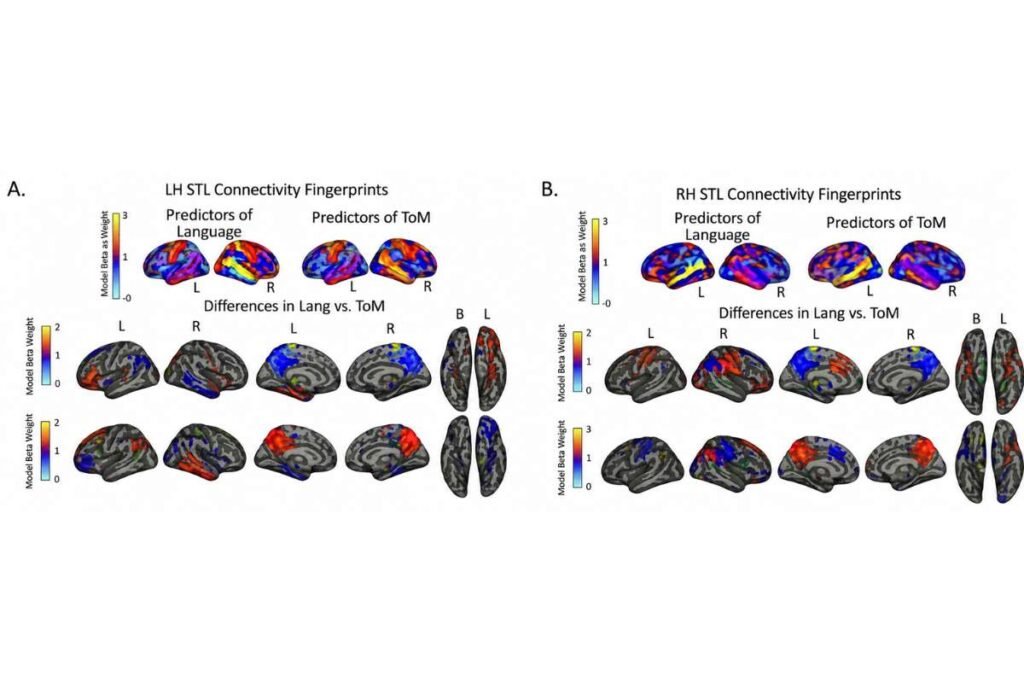
Children Born Study goes beyond identifying brain locations, as researchers analyzed how each region communicates with the rest of the brain during rest periods. These communication patterns, known as “connectivity fingerprints,” help determine how different brain areas function.
Using predictive modeling, scientists found that language and social cognition networks maintained unique communication patterns, reinforcing their independence.
“If you observe how a region talks to the rest of the brain, that gives you an idea about how it functions,” Hiersche said.
Longitudinal analysis showed the separation remained stable within individual children over time. Researchers found no evidence that the networks begin to overlap in younger children and later diverge.
Instead, the brain appears to be organized with specialized systems from early development.
Comparisons between children and adults revealed one notable change: while the systems remain distinct, adult brains show slightly increased interaction between language and social cognition networks.
“In adults, the theory-of-mind network starts to talk to slightly similar regions as language areas,” Saygin said, suggesting growing coordination between complementary skills as people mature.
Children Born Study researchers say the results support the idea that human cognition evolved with dedicated neural structures for communication and social understanding rather than a single shared origin.
The findings offer new insight into how human intelligence develops and may help scientists better understand developmental conditions affecting language or social processing.
Visit Healthcare 360 Magazine For The Most Recent Information.