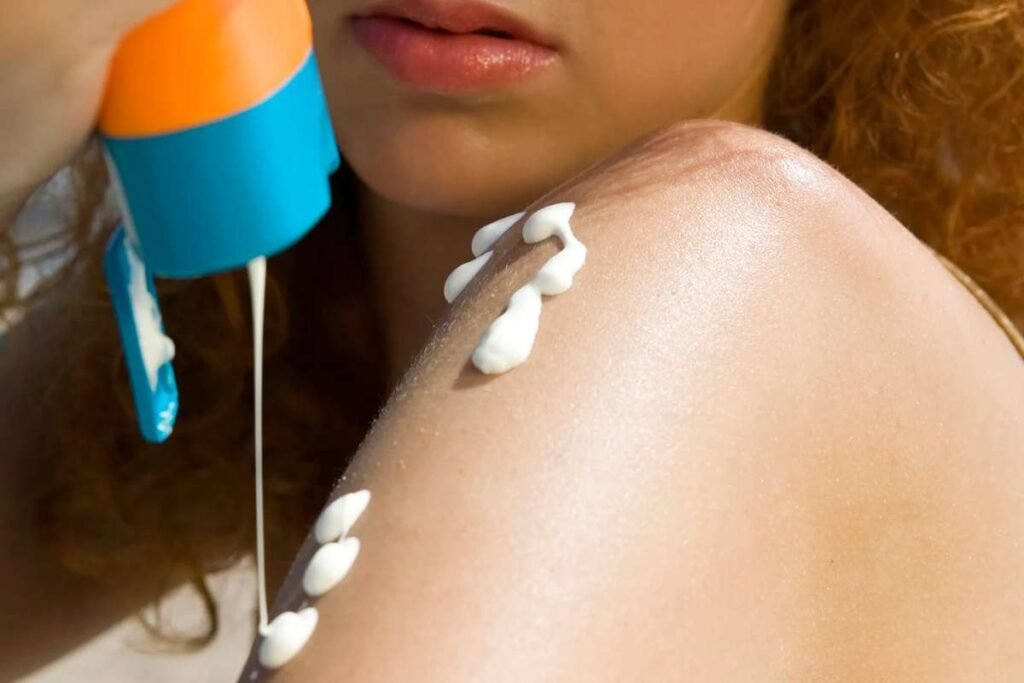
The Food and Drug Administration on Thursday proposed allowing Bemotrizinol, a broad-spectrum sunscreen ingredient long used in Europe and Asia, to be included in U.S. products as part of an effort to expand safer and more effective UV protection options. The FDA sunscreen proposal marks a major regulatory step toward modernizing American sunscreen formulas and giving consumers access to ingredients widely available abroad.
The FDA said the proposal begins a formal review process that could enable manufacturers to use the ingredient without filing a separate drug application, provided it meets agency requirements. Bemotrizinol would be the first new UV filter cleared in the United States in more than twenty-five years a key milestone highlighted in the FDA sunscreen proposal.
FDA Commissioner Dr. Marty Makary said the move reflects an attempt to modernize the agency’s approach to over-the-counter sunscreen regulation. “The agency has historically moved too slowly in this area, leaving Americans with fewer options than consumers abroad,” Makary said in a statement.
FDA Cites Safety, Stability in Proposal
Bemotrizinol has been widely available in Europe, Australia and parts of Asia for years, where it is classified as a cosmetic ingredient rather than an over-the-counter drug. In the U.S., sunscreen filters require safety and efficacy data similar to drug products, which has slowed the introduction of new ingredients making the FDA sunscreen proposal even more significant.
Dr. Steven Wang, chief of dermatology at Hoag Memorial Hospital Presbyterian in Newport Beach, California, said the ingredient has a strong safety record. “Bemotrizinol does not penetrate the body surface and does not absorb into the bloodstream, so it has a good safety profile,” Wang said.
Experts say its stability under sunlight could make it more durable than existing chemical filters, which often degrade and require frequent reapplication. The FDA noted such features in its rationale for advancing the proposal.
Experts Highlight Broad-Spectrum Benefits
Dermatologists emphasize Bemotrizinol’s broad-spectrum protection, which covers both UVA and UVB rays an advantage over many current U.S. sunscreen ingredients. Experts say this aligns with the goals of the FDA sunscreen proposal, which aims to provide consumers with more effective and less irritating sunscreen options.
“The ‘B’ is burning rays, which cause sunburn. The ‘A’ is the aging ray, which causes tanning reaction and wrinkle formation,” said Dr. Henry Lim, former chair of dermatology at Henry Ford Health and past president of the American Academy of Dermatology. Both, he said, contribute to skin cancer risk.
Dr. Adam Friedman, chair of dermatology at the GW School of Medicine and Health Sciences in Washington, D.C., said the ingredient appears less irritating than many existing options. “It does seem to be better tolerated in comparison to other UV filters,” Friedman said, noting that irritation can be a barrier for people with acne, eczema or rosacea.
Public Comment Period Sets Timeline for Rollout
Under FDA rules, the proposal must undergo a public comment period before the agency can issue a final order adding bemotrizinol to its list of approved sunscreen ingredients. The FDA said it expects that final order sometime next summer or fall.
Ben Nichols, an FDA spokesman, said sunscreens containing the ingredient could reach store shelves as early as late 2026 if the timeline holds.
Experts say the FDA sunscreen proposal could bring U.S. sunscreen options closer to those available internationally. “Bemotrizinol will be a welcome addition to the U.S. sunscreen industry,” Wang said.
Also Read : The Guide to Beauty and Skincare: Unlocking Radiant and Healthy Skin