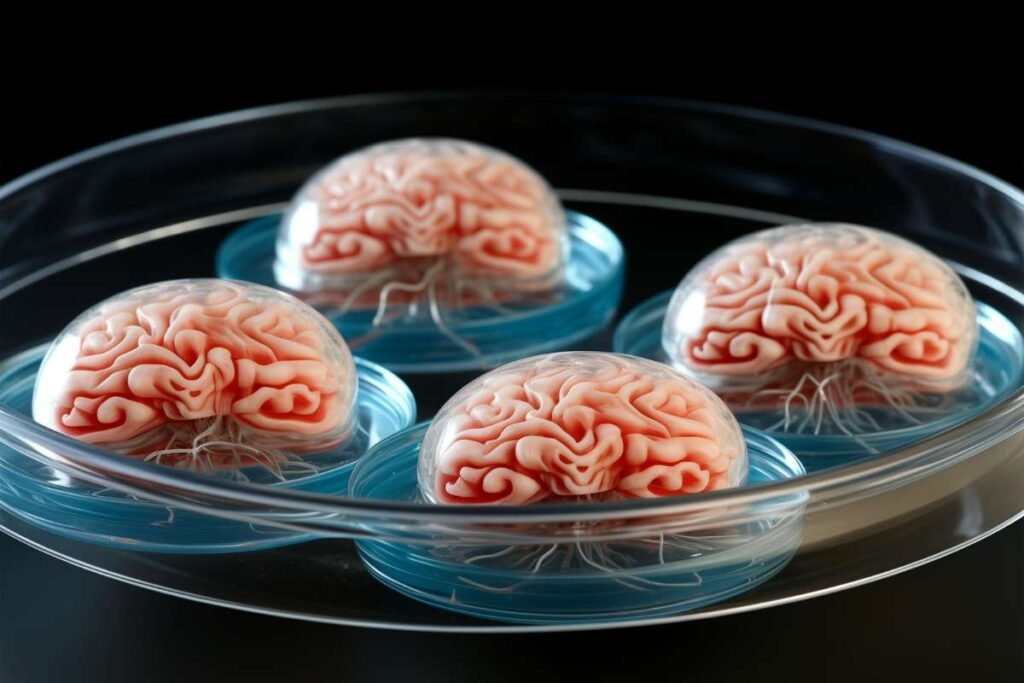
Scientists worldwide are advancing lab-grown mini brains from stem cells that mimic human brain activity, offering breakthroughs in disease research while raising urgent ethical concerns about consciousness, pain perception, and regulation.
Scientists Develop Advanced Brain Organoids
Researchers are rapidly improving brain organoid technology, creating three-dimensional clusters of brain cells grown from stem cells that resemble parts of the human cortex and display complex neural activity.
Over the past decade, scientists have developed organoids capable of forming diverse brain cell types and structural patterns similar to early human brain development. These models allow researchers to study neurological diseases and developmental disorders without experimenting directly on human subjects.
Dr. Paula Arlotta, a neuroscientist at Harvard University, said her team has kept some organoids alive for up to seven years, enabling long-term observation of how brain tissue grows and matures.
“We can now observe processes that were previously impossible to study in living humans,” Arlotta said. “It opens an entirely new window into brain development.”
Scientists say such models could accelerate research into autism, epilepsy, and neurodegenerative diseases while reducing reliance on animal testing.
Linked Organoids Show Integrated Brain Functions
Researchers are also experimenting with connecting multiple lab-grown mini brains to simulate communication between brain regions.
At Stanford University, neuroscientist Sergiu Pasca and colleagues created linked structures known as “neural assembloids,” combining separate organoids to replicate interactions found in developing brains.
Pasca said some assembloids demonstrate coordinated electrical activity and responses to sensory signals, suggesting increasingly sophisticated neural integration.
“These systems help us understand how different brain regions communicate during development,” Pasca said. “But they also force us to consider new ethical boundaries.”
Some studies report neural patterns resembling responses associated with pain signaling, intensifying debate over whether advanced lab-grown mini brains could eventually achieve rudimentary awareness.
Experts Call For Global Ethical Oversight
As lab-grown mini brains become more complex, ethicists and scientists are urging international guidelines to govern their use.
Researchers warn that future models could reach levels of organization that challenge existing definitions of consciousness, raising questions about moral status and experimental limits.
Bioethics scholars have proposed creating a global oversight body similar to the International Society for Stem Cell Research to establish standards for monitoring organoid complexity and ensuring responsible experimentation.
“Science is moving faster than policy,” said Dr. Laura Kim, a bioethicist not involved in the research. “We need shared global rules before technological capability outpaces ethical consensus.”
Supporters argue that careful regulation can balance scientific progress with ethical responsibility, preventing misuse while preserving the technology’s medical potential.
Scientists emphasize that current lab-grown mini brains do not possess consciousness or intelligence comparable to humans. Still, many agree that proactive governance is essential as the field evolves.
The debate reflects a broader challenge facing modern biotechnology: how to encourage innovation while addressing moral questions raised by increasingly humanlike laboratory models.
Visit more of our news! Healthcare 360 Magazine