Key Takeaway:
- Scientists identified the first known transmissible cancer in fish, with genetic evidence suggesting melanoma tumors spread between brown bullhead catfish.
- Researchers believe transmission may occur during spawning, but laboratory confirmation has not yet been achieved.
- Officials advise against eating fish with visible tumors, although there is currently no evidence the cancer poses a risk to humans.
Researchers report the first known transmissible cancer in fish after genetic evidence shows melanoma tumors in brown bullhead catfish from Quebec and northeastern U.S. lakes appear to spread between animals rather than arise independently.
Genetic Evidence Points to Rare Transmissible Cancer
A study published Wednesday in Nature found that melanoma tumors affecting brown bullhead catfish are genetically more similar to one another than to the fish carrying them, suggesting the cancer itself may spread from fish to fish.
The discovery marks the first documented case of transmissible cancer in fish and only the fourth known transmissible cancer identified in nature. Previous cases have been found in Tasmanian devils, dogs and shellfish.
“This is incredibly rare in nature,” said Julie Dragon, co-leader of the study and an associate professor of microbiology and molecular genetics at the University of Vermont’s Larner College of Medicine. She said researchers believe “something has to be happening to allow this to happen.”
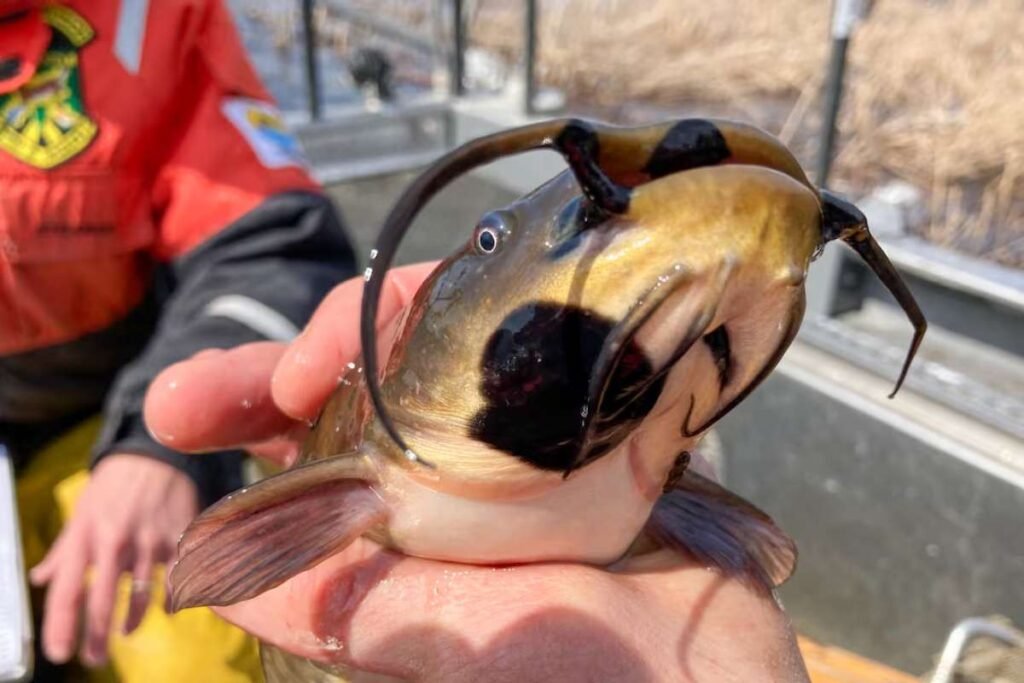
Anglers first reported unusual black spots and lumps on brown bullhead catfish in Lake Memphremagog, which spans Quebec and Vermont, in 2012. Researchers later identified the lesions as melanoma. About one-third of the lake’s brown bullheads now show signs of the disease.
Scientists said some fish develop tumors that spread to organs such as the brain and liver, while others appear to survive with the disease for extended periods.
Researchers Investigate How Disease May Spread
The tumors appeared shortly after severe flooding caused by post-tropical storm Irene, prompting concerns that contaminants washed into the lake triggered the disease.
Researchers initially tested for viruses and signs of inbreeding but found neither explanation fit the evidence. Genetic analysis instead showed healthy and infected fish had substantial genetic diversity, while tumor cells closely matched one another across different fish.
Dragon said one theory is that cancer cells spread during spawning, when adult catfish gather in dense groups and frequently make contact with one another.
“They swim all over each other, and we think it’s possible that they poke each other and cells can get into other fish that way,” Dragon said.
Researchers have not yet demonstrated direct transmission under laboratory conditions but hope to conduct those experiments later this year.
Experts Debate Findings as Monitoring Continues
Some scientists say more evidence is needed before confirming the transmissible cancer in fish is spread directly between animals.
“I guess my first concern is to call something a transmissible anything when you haven’t transmitted it,” said Vicki Blazer, a retired U.S. Geological Survey scientist who is studying whether contaminants, including PFAS, could contribute to the disease.
Stephen Goff, a Columbia University researcher who was not involved in the study but previously researched transmissible cancer in shellfish, said the genetic findings are “totally compelling” and support the conclusion that the tumors spread between fish.
The study received funding from U.S. and Vermont government agencies, including the National Institutes of Health and the Great Lakes Fishery Commission, with additional support from Quebec’s Ministry of the Environment.
Officials in Quebec recommend that anglers avoid eating fish with visible tumors, although researchers said there is no evidence the transmissible cancer in fish poses a risk to human health. Tumor-bearing catfish have also been identified in Lake Magog and lakes in Maine and New Hampshire, and Quebec officials continue asking anglers to report suspected cases to help track the disease.
Visit Healthcare 360 Magazine to read more.