
Frequent nighttime urination, a weaker urine stream, or difficulty maintaining an erection can seem like ordinary signs of aging. Yet persistent changes deserve attention. Prostate cancer is the most commonly diagnosed cancer among men in the United States after skin cancer, with approximately 1 in 8 men facing a lifetime risk of diagnosis, and it often stays silent in the early stages. Symptoms usually appear only when the tumor grows or presses on nearby structures. Because benign prostatic hyperplasia (BPH) and prostatitis cause similar problems, confusion is common, and symptoms alone cannot diagnose prostate cancer, as many of these signs have non-cancer causes.
This guide explains the 12 symptoms of prostate cancer, advanced warning signs, key risk factors, and the diagnostic steps that confirm what is really happening.
12 Symptoms of Prostate Cancer Men Should Recognize
Symptoms of prostate cancer can include changes in urination, blood in urine or semen, erectile difficulties, and persistent pelvic discomfort. However, early prostate cancer often causes no noticeable symptoms.
Urinary changes

1. Frequent urination, especially at night (nocturia):
You may wake repeatedly to pass urine; an enlarged prostate can press on the urethra. Often related to benign prostate enlargement or other causes.
2. Difficulty starting urination:
You may need to wait or strain before urine flows; this can occur when the prostate blocks urine flow. Also common with non-cancerous prostate conditions.
3. Weak or interrupted urine stream:
The flow may be slow, dribbling, or stop and start. This can happen with prostate enlargement as well as cancer.
4. Incomplete bladder emptying:
You may still feel the need to urinate after going. This may reflect obstruction and has several possible causes.
5. Urinary urgency or leakage:
You may feel a sudden, hard-to-control need to urinate. More often linked with advanced disease or other urinary conditions.
6. Pain or burning during urination:
This may feel like stinging or discomfort. It is more commonly due to infection or inflammation, but should be checked.
Sexual and reproductive changes
7. Erectile dysfunction:
Difficulty getting or keeping an erection can occur with advanced prostate cancer, but it is also very common with aging, diabetes, and vascular disease.
8. Blood in semen (hematospermia):
Semen may look pink, red, or brown. It requires medical assessment, though infection and other conditions can cause it.
9. Painful ejaculation:
Pain during or after ejaculation may occur if the prostate is affected. It can also result from infection or inflammation.
Other physical changes
10. Blood in urine (hematuria):
Urine may appear pink, red, or cola-colored. This always warrants prompt evaluation.
11. Persistent lower-back, hip, or pelvic discomfort:
Pain that does not improve may occur if cancer has spread to bone; it is more suggestive of advanced disease.
12. Unexplained fatigue or weight loss:
These are nonspecific symptoms and can have many causes, but persistent unexplained changes should be assessed.
These symptoms do not necessarily indicate prostate cancer, and some, such as bone pain and unexplained weight loss, are more commonly associated with advanced disease.
What Do Advanced Prostate Cancer Symptoms Look Like?
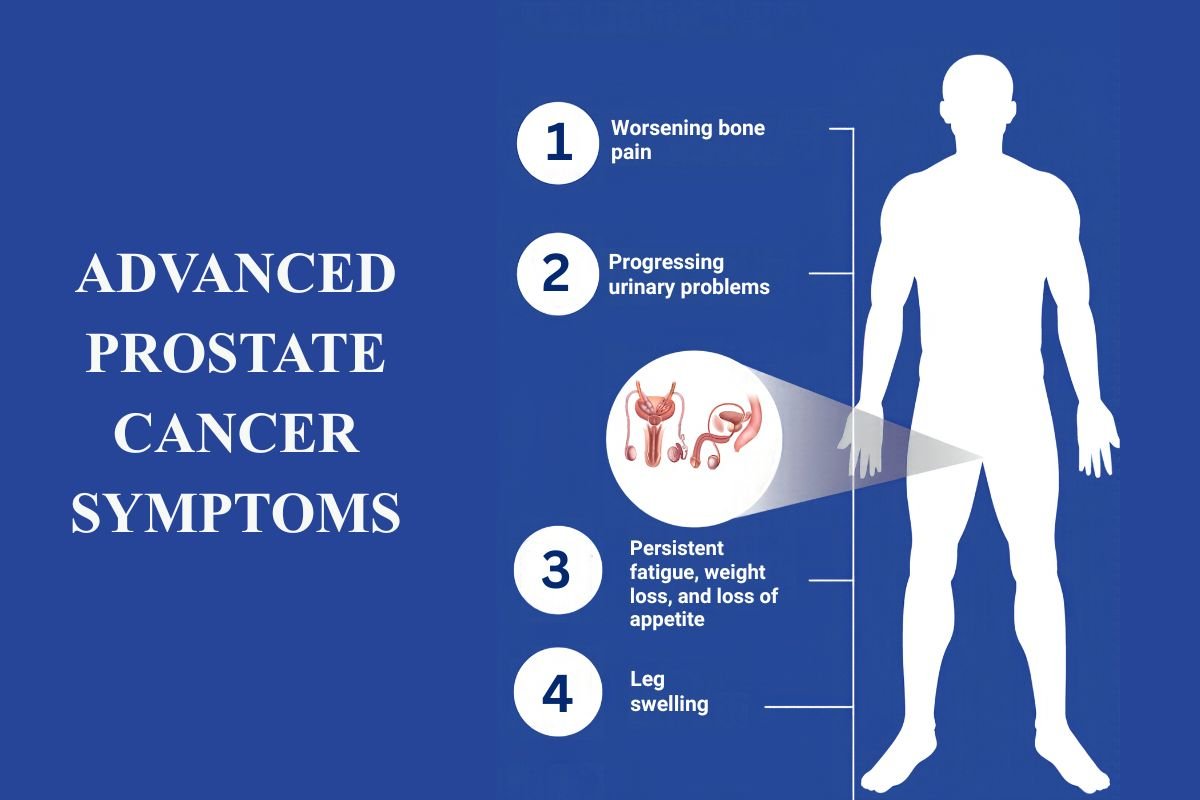
When prostate cancer grows beyond the prostate or spreads, symptoms may become more persistent and affect bones, energy levels, and urination. Prostate cancer most often spreads to bones and can also involve nearby lymph nodes.
Possible advanced symptoms
- Worsening bone pain: Pain in the lower back, hips, pelvis, or upper thighs that intensifies or does not go away.
- Progressing urinary problems: Earlier symptoms such as a weak stream or incomplete emptying can worsen if the tumor presses on the urethra or bladder area.
- Persistent fatigue, weight loss, and loss of appetite: Tiredness that does not improve with rest may be related to cancer, anemia, or treatment effects.
- Leg swelling: Swelling in the legs or feet can occur if lymph nodes are involved or lymph drainage is blocked.
These symptoms of prostate cancer do not reliably show the cancer’s stage. Imaging tests, blood tests, and biopsy findings help doctors determine whether prostate cancer has spread and assess its stage.
Also Read: Urinary Tract Infection Treatment -How to End this Infection?
Prostate Cancer vs. Enlarged Prostate and Prostatitis
Prostate cancer, benign prostatic hyperplasia (BPH), and prostatitis can all affect urination and cause pelvic discomfort. So their symptoms often overlap. Similar symptoms do not mean the conditions are interchangeable. Testing is needed to identify the cause.
How they differ
| Feature | Prostate cancer | BPH | Prostatitis |
| Frequent urination | Possible | Common | Possible |
| Weak urine flow | Possible | Common | Possible |
| Painful urination | Possible | Less typical | Common in some forms |
| Pelvic pain | Possible | Less typical | Common |
| Blood in urine | Possible | Possible | Possible |
- BPH is a noncancerous enlargement of the prostate that can press on the urethra and slow urine flow.
- Prostatitis is inflammation of the prostate, sometimes with infection, fever, burning urination, or pelvic pain.
- Prostate cancer involves abnormal cancer-cell growth; early disease often causes no symptoms
The symptoms of prostate cancer can resemble those of BPH and prostatitis. So a clinician may use a medical history, physical exam, urine and blood tests, imaging, and sometimes biopsy to distinguish them.
Who Is at Higher Risk of Prostate Cancer?
Men at higher risk of prostate cancer include older men, those with a family history, people with certain inherited gene changes, and Black men. Because early disease often has no signs, risk should guide when to discuss screening, not just whether symptoms of prostate cancer appear.
Main risk factors
- Age: Risk rises with age, especially after 50. It is rare before age 40.
- Family history: Having a father, brother, or son with prostate cancer increases risk; a brother’s diagnosis raises risk more than a father’s.
- Inherited genetic changes: BRCA1 and BRCA2 variants and some other inherited changes can increase susceptibility.
- Race and ethnicity: Black men in the United States have a higher risk of developing prostate cancer, often at a younger age, and are more likely to have advanced disease when diagnosed.
Men with a strong family history or inherited risk may need to discuss screening earlier rather than waiting for symptoms. Screening decisions should consider individual risk, potential benefits and harms, and current local medical guidance.
Also Read: How to Spot Early Signs of Diabetes Before They Become a Crisis?
How Is Prostate Cancer Diagnosed?

Prostate cancer is usually evaluated through a step-by-step process: initial tests look for warning signs, while a biopsy confirms whether cancer cells are present. Symptoms of prostate cancer alone cannot confirm the diagnosis.
Diagnostic steps
1. PSA blood test:
Measures prostate-specific antigen, a protein made by the prostate. A high PSA can suggest prostate cancer, but it can also rise with benign prostatic hyperplasia (BPH), prostatitis, or certain medicines.
2. Digital rectal examination (DRE):
A clinician inserts a gloved, lubricated finger into the rectum to feel the prostate for lumps, hard areas, or other abnormalities.
3. MRI scan:
MRI can help identify suspicious areas in the prostate and guide the biopsy to the right location.
4. Prostate biopsy:
A clinician removes small tissue samples, usually with a core needle, and a pathologist examines them under a microscope for cancer cells.
A PSA test, physical examination, and MRI can help identify suspicious changes, but a prostate biopsy is generally needed to confirm whether cancer cells are present.
Conclusion:
Symptoms of prostate cancer can be easy to overlook, since early disease is often silent and urinary changes are frequently blamed on aging. Persistent or worsening signs, such as blood in the urine or semen, a weak stream, or lasting pelvic or back pain, deserve a medical check. Similar symptoms can result from BPH or prostatitis, so medical evaluation, which may include PSA testing, a physical examination, MRI, and biopsy, helps identify the underlying cause. Risk factors like age, family history, inherited gene changes, and ethnicity should also guide when to discuss screening.
If something feels off, don’t wait. Book an appointment with your doctor and talk through your symptoms and risk today.
FAQ:
1. What are usually the first noticeable symptoms of prostate cancer?
Early prostate cancer often causes no symptoms, but urinary changes such as frequent urination or a weak urine stream may appear as it progresses.
2. Can erectile dysfunction be an early symptom of prostate cancer?
Erectile dysfunction can occur in men with prostate cancer, although it is not a specific or reliable early warning sign.
3. Can prostate cancer cause lower back or hip pain?
Yes, persistent lower back, hip, or pelvic pain can occur when prostate cancer spreads to nearby tissues or bones.
4. How can you tell the difference between prostate cancer and an enlarged prostate?
Both can cause urinary difficulties, so medical examinations and appropriate tests are necessary to distinguish them.
5. Can prostate cancer cause pain while urinating?
Yes, painful urination is possible, although infections and prostatitis are more common causes.