
Think about the last time you visited a hospital. How quickly were test results reviewed? How soon did the care team spot a potential issue? Behind many of these moments, intelligent systems are already at work.
Healthcare delivery is changing as algorithms help doctors interpret data, track patient conditions, and support decisions in real time. These tools work quietly in the background, helping care teams respond faster and more accurately. For patients, this often means safer care, fewer delays, and better outcomes across hospitals and clinics.
AI-powered healthcare organizations rely on artificial intelligence to improve accuracy, speed, and efficiency across medical workflows. AI supports medical imaging, risk prediction, administrative automation, and treatment planning. By turning large volumes of data into actionable insights, AI-powered healthcare organizations help care teams make better decisions and improve patient outcomes.
But first, we must take a look at some of the AI components that are applied in the healthcare systems used by top companies.
Core AI Components Powering Healthcare Systems Today
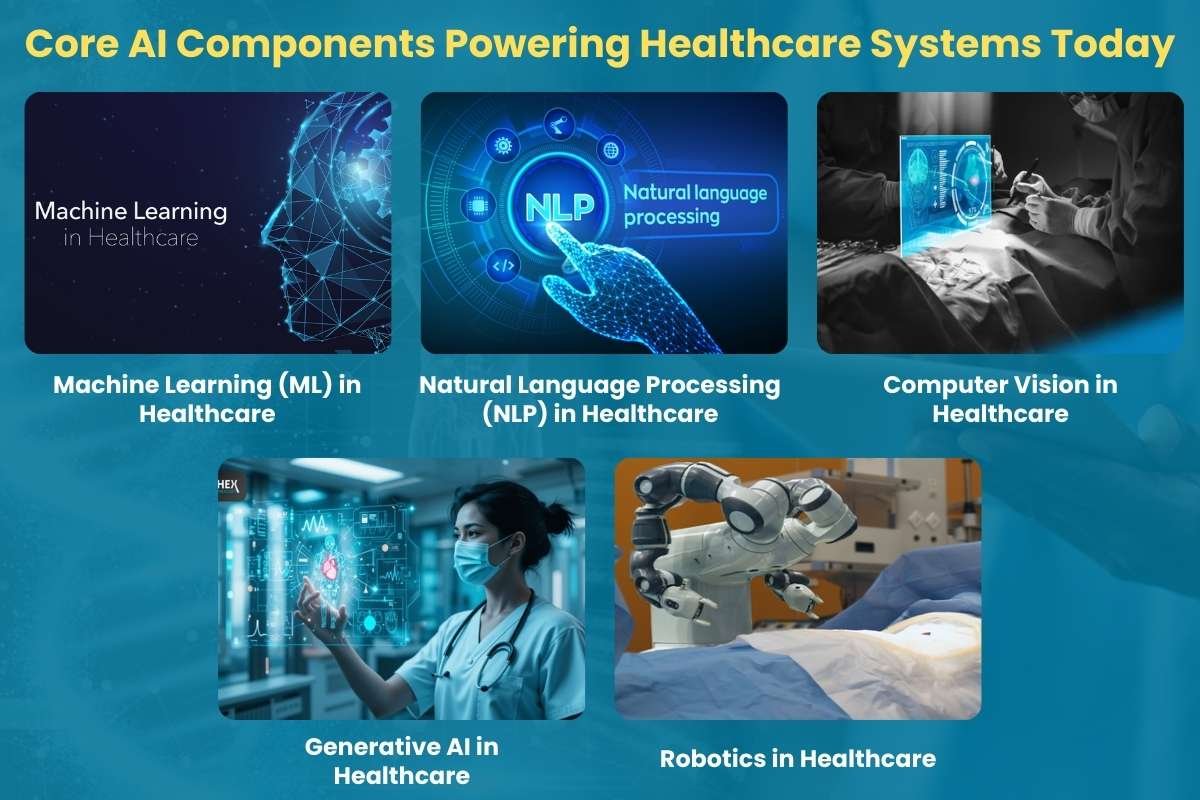
Healthcare systems today are powered by intelligent technologies behind the scenes. Core AI components like machine learning, natural language processing, and computer vision enable faster diagnoses, predictive insights, and smarter operations. This section highlights the key AI elements driving efficiency, accuracy, and innovation in modern healthcare.
1. Machine Learning (ML) in Healthcare
Machine Learning sits at the center of modern healthcare AI. ML models learn patterns from large datasets such as medical images, lab results, and patient histories. Hospitals use these models to predict disease risks, patient deterioration, and readmission. Doctors receive alerts early, often before symptoms appear.
In radiology, ML analyzes X-rays, CT scans, and MRIs quickly. These systems detect pneumonia, fractures, tumors, and cardiovascular risks with high accuracy. ML-based imaging tools reduce delays and lighten the radiologist’s workload. ML also supports predictive analytics for sepsis, stroke, and cancer progression.
ML drives personalized medicine. Algorithms compare genetic data with treatment outcomes to suggest therapies. AI-powered healthcare organizations also use ML through Oncology teams to match patients with targeted treatments faster. Research hospitals report better response rates and fewer adverse reactions through ML-guided decisions.
2. Natural Language Processing (NLP) in Healthcare
NLP helps healthcare systems understand unstructured medical language. Clinical notes, discharge summaries, and doctor dictation contain valuable data. NLP extracts diagnoses, medications, symptoms, and timelines automatically. This reduces manual data entry and errors.
Hospitals use NLP to update electronic health records in real time. Doctors spend less time typing and more time with patients. NLP systems flag risk indicators hidden in progress notes. Early signs of sepsis, heart failure, or mental health issues often appear in text before labs confirm them.
NLP also automates medical coding and billing. Algorithms read documentation and assign accurate codes. Health systems report fewer rejected claims and faster reimbursements. Revenue cycle teams gain speed without losing accuracy.
3. Computer Vision in Healthcare
Computer Vision lets machines understand medical images and video feeds. It plays a key role in diagnostics, surgery, and patient monitoring. AI now supports radiology, pathology, dermatology, and ophthalmology workflows.
AI-powered healthcare organizations use computer vision to track patient movement without wearable devices. Systems monitor breathing, fall risks, and posture using room cameras. Intensive care units use these tools for constant observation while reducing sensors.
Surgical teams rely on computer vision too. AI-assisted systems guide precision during minimally invasive procedures. These tools improve accuracy and reduce complications. Surgeons get real-time visual cues that enhance control and safety.
4. Generative AI in Healthcare
Generative AI changes how clinicians document and communicate care. These systems generate clinical notes, discharge summaries, and patient instructions automatically. Doctors dictate or input data, and the system produces complete documentation.
Healthcare organizations report big time savings with generative AI. Clinicians reduce administrative work while improving record quality. This leads to better continuity of care and fewer documentation gaps.
Generative AI also improves patient engagement. Systems create personalized follow-ups, medication reminders, and care plans. Patients receive clear instructions that match their condition and history. This improves adherence and satisfaction.
5. Robotics in Healthcare
Robotic systems combine AI, sensors, and automation to help with physical tasks. In surgery, robots provide stability, precision, and consistency. Surgeons control them while AI optimizes movement and positioning.
Hospitals use robots for logistics and patient care. They deliver supplies, disinfect rooms, and transport medications. This reduces staff fatigue and infection exposure. Robotic automation improves efficiency across large facilities.
AI-powered healthcare organizations use robots for physical therapy. Systems adjust resistance and movement based on patient progress. Patients recover faster with personalized robotic support.
READ MORE:
- How AI Healthcare Efficiency Is Transforming Modern Hospitals and Clinics?
- Harnessing the Power of Health Information Technology
Here are 5 AI-Powered Healthcare Organizations Using these Components
Leading healthcare organizations are increasingly integrating AI into their daily operations to enhance patient care and streamline workflows. By leveraging advanced algorithms and smart data analysis, they can make faster, more accurate decisions. This section explores how different AI components are applied across medical imaging, predictive analytics, and administrative tasks to transform healthcare delivery.
1. Mayo Clinic

At Mayo Clinic, AI helps doctors, researchers, and staff. It runs over 200 AI projects across patient records, scans, and lab data. AI looks for patterns to spot disease early and suggest better treatments.
- Machine Learning: Mayo uses ML to find trends in patient data. It can predict heart problems, cancer risks, and other serious conditions. Doctors get alerts early, which helps save lives and improve care. ML also reduces the time spent reading large data sets.
- Natural Language Processing: NLP helps process long clinical notes. It finds key information and summarizes patient histories. Doctors can see important details quickly. NLP also supports research by scanning studies and papers efficiently.
- Computer Vision: AI vision tools review scans and slides fast. It detects possible tumors or abnormalities for doctors to check. Radiologists can focus on high-risk cases, improving early detection.
- Generative AI: Mayo tests AI that writes clinical summaries. It also drafts research notes. Doctors review everything, but it saves time and reduces workload.
- Robotics and Automation: Robots assist in surgery and move supplies inside hospitals. They improve precision, speed up recovery, and free staff for patient care.
2. Kaiser Permanente

Kaiser Permanente uses AI in many areas of care. It focuses on patient safety and responsible AI use. AI tools are tested before they help clinicians make decisions.
- Machine Learning: Kaiser’s system watches patient data hourly. It predicts health problems before they happen. Care teams get alerts, allowing faster intervention. This system saves lives and improves outcomes.
- Natural Language Processing: NLP converts conversations and notes into structured records. Doctors spend less time typing and more time with patients. It also helps interpret patient messages efficiently.
- Computer Vision: AI highlights areas in scans like mammograms. Radiologists check these flagged regions first. This improves early detection and reduces missed cases.
- Generative AI: AI drafts clinical notes and patient instructions. Doctors edit the drafts before using them. This reduces documentation time and helps focus on care.
- Robotics & Automation: Automation helps staff manage workflows. AI clears routine tasks and sends alerts to care teams. Fewer physical robots are used, but efficiency increases.
3. IBM Watson Health (Merative)
IBM Watson Health uses AI to guide doctors and researchers. The system combines data from records, studies, and trials to suggest treatments. It supports complex decisions in oncology and chronic care.
- Machine Learning: ML learns from patient data to recommend treatment options. Watson often matches expert panels in cancer care studies. This helps doctors make faster, data-driven decisions.
- Natural Language Processing: NLP scans research papers and patient notes. It finds key insights and matches patients to clinical trials. Doctors spend less time searching for information.
- Computer Vision: AI reviews imaging scans. It flags potential problems for radiologists. This speeds diagnosis and ensures no details are missed.
- Generative AI: AI summarizes research papers and patient histories. Doctors get concise insights for faster planning.
- Robotics & Automation: AI helps automate administrative and workflow tasks. It supports large hospitals without replacing humans.
4. Siemens Healthineers

Next on this list of AI-powered Healthcare Organizations is Siemens Healthineers. It uses AI mainly in imaging and diagnostics. The company focuses on ML and computer vision to improve hospital devices.
- Machine Learning: ML optimizes scans in real time. It improves image clarity while reducing radiation exposure. Patients benefit from faster and safer procedures.
- Natural Language Processing: NLP standardizes report language in radiology. This helps doctors communicate clearly and reduces confusion.
- Computer Vision: AI scans images to detect subtle signs of disease. It also guides surgeons with enhanced visuals during procedures.
- Generative AI: Siemens uses AI to create training simulations. Doctors can practice safely with virtual cases.
- Robotics & Automation: Automated robots help with imaging tasks. They position patients, reduce setup time, and free staff to focus on care.
5. Google Health
Google Health applies AI in research and clinical care. It is amongst the few AI-powered healthcare organizations that focus on imaging, disease detection, and patient support tools.
- Machine Learning: ML detects diseases like diabetic eye disease. It often performs as well as expert doctors in tests. Patients can be screened earlier with these tools.
- Natural Language Processing: NLP interprets patient questions and guides care decisions. It helps reduce unnecessary clinic visits.
- Computer Vision: AI scans images to highlight potential problems. Doctors can check flagged areas first. This improves early diagnosis.
- Generative AI: AI summarizes records and literature for doctors. It helps clinicians quickly find key information.
- Robotics & Automation: AI-powered robots assist in rehabilitation. They adjust exercises based on patient progress, improving recovery and mobility.
Conclusion:
Artificial intelligence is transforming healthcare, and AI-powered healthcare organizations are at the forefront of this change. By analyzing vast amounts of data, automating routine tasks, and supporting clinical decisions, AI helps improve accuracy, efficiency, and patient outcomes. The integration of AI into healthcare is about smarter, faster, and more personalized care for every patient. As AI continues to evolve, these organizations are setting new standards for how care is delivered and experienced.
FAQs
1. How is AI used in healthcare organizations?
AI is applied in medical imaging analysis, patient monitoring, predictive analytics, administrative automation, and personalized treatment recommendations.
2. Can AI replace doctors in healthcare?
No. AI supports clinical decisions and improves efficiency, but human expertise remains essential for patient care and judgment.
3. Are AI-powered healthcare organizations safe for patients?
Yes, when implemented with proper validation, oversight, and integration with clinical workflows, AI tools are designed to enhance safety and care quality.