Yoga poses that can help relieve menstrual cramps may ease pain by relaxing muscles, improving mobility, and promoting calm breathing. Learn eight beginner-friendly poses, a 10-minute routine, breathing techniques, safe modifications, and when medical care is necessary for severe or unusual period pain.
Period cramps can make it hard to walk, work, or concentrate. But gentle movement can help a lot. Yoga poses that can help relieve menstrual cramps can ease muscle tension, encourage relaxation, and boost comfort, making them an excellent addition to heat therapy, medication, and other remedies. Researchers from Korea did a meta-analysis of four randomized controlled trials with 230 people and found that yoga was associated with decreased pain in people with primary dysmenorrhea, although they noted that more high-quality studies are needed.
This guide will teach you which poses might help, how breathing and gentle stretching can work, how to build a short menstrual cramp routine, and what movements to modify or avoid. You’ll also find out what the latest research really says, and when serious or weird period pain merits a medical exam.
Table of Contents
How Do Yoga Poses That Can Help Relieve Menstrual Cramps Work?
Excess prostaglandins (hormone-like chemicals) cause uterine contractions to shed the uterine lining, reducing blood flow and triggering pain, inflammation, and cramping.
How Movement & Breathing Help
- Improves Circulation & Mobility: Gentle stretching of the hips, lower back, abdomen, and pelvis eases muscle tightness, stiffness, and lower-back discomfort.
- Calms the Nervous System: Slow, deep breathing releases stress-related muscle tension, shifting the focus away from pain perception.
What Research & Practice Suggest
- Promising Evidence: Small studies show yoga can reduce menstrual pain and improve quality of life, though higher-quality research is still needed.
- Best Approach: Practice gently and consistently without forcing deep stretches.
- Medical Guidance: Use yoga alongside heat, rest, or medical care. Consult a healthcare provider for severe, worsening pain or conditions like endometriosis.
Best 8 Yoga Poses That Can Help Relieve Menstrual Cramps:
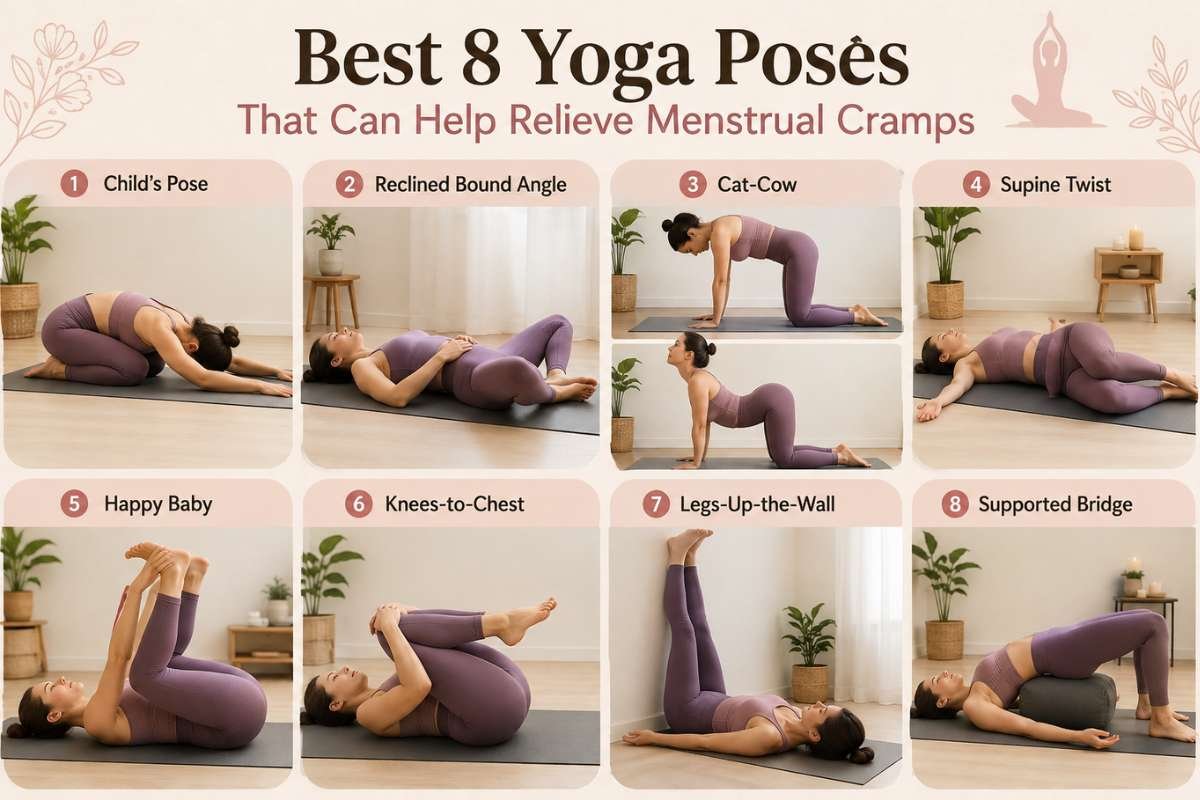
Move slowly, breathe comfortably, and stop if pain worsens. Yoga should feel supportive, not forced. MedlinePlus recommends modifying poses for conditions such as pregnancy, glaucoma, high blood pressure, sciatica, or arthritis, and stopping if you feel pain or fatigue.
| Pose | Best for | Hold time | Beginner friendly |
| Child’s Pose | Pelvic cramps | 1–3 minutes | ✓ |
| Reclined Bound Angle | Pelvic tension | 3–5 minutes | ✓ |
| Cat-Cow | Lower-back pain | 1 minute | ✓ |
| Supine Twist | Bloating | 1–2 minutes | ✓ |
| Happy Baby | Hip tightness | 1 minute | ✓ |
| Knees-to-Chest | Gas and abdominal pressure | 1–2 minutes | ✓ |
| Legs-Up-the-Wall | Fatigue | 5 minutes | With caution |
| Supported Bridge | Mild cramps | 1–2 minutes | Moderate |
How to Practise Each Pose:
1. Child’s Pose:
Kneel, bring your hips toward your heels, and fold forward with your arms extended or supported on a cushion. Avoid forcing your hips down; skip it if it worsens knee pain or causes uncomfortable abdominal pressure.
2. Reclined Bound Angle:
Lie on your back, bring the soles of your feet together, and let your knees open gently. Support both knees with cushions; avoid pressing them down and skip the pose if it causes hip or groin pain.
3. Cat-Cow:
Start on your hands and knees, then slowly alternate between rounding and lengthening your spine. Keep your movements comfortable; skip it if wrist, shoulder, or back pain increases.
4. Supine Twist:
Lie on your back, bend your knees, and lower them slowly to one side while keeping your shoulders relaxed. Do not force the twist; skip it if it increases cramps, back pain, or dizziness.
5. Happy Baby:
Lie on your back and hold your feet, ankles, or thighs while gently drawing your knees toward your armpits. Avoid pulling forcefully; skip it with hip, groin, or lower-back pain.
6. Knees-to-Chest:
Lie down and draw one or both knees toward your chest while breathing normally. Do not hold your breath or compress the abdomen excessively; skip it if pressure feels painful.
7. Legs-Up-the-Wall:
Lie near a wall and rest your legs upward while keeping your head and neck relaxed. Avoid this pose if it worsens dizziness, glaucoma, or blood-pressure symptoms.
8. Supported Bridge:
Lift your hips gently and place a yoga block beneath the sacrum for support. Do not place the block directly under the lower back; skip it if you develop neck or back pain.
Also Read: 7 Yoga Poses to Help Promote Digestion (Plus a Simple Daily Routine)
A 10-Minute Yoga Routine for Period Pain:
This gentle sequence combines breathing, comfortable movement, and supported stretches. It may help reduce muscle tension and make menstrual discomfort easier to manage, but it is not a cure. Research on yoga for menstrual pain is encouraging, although more high-quality studies are needed.
1) Minute 1–2: Breathing
Lie comfortably or sit supported. Place one hand on your abdomen and breathe in slowly through your nose, allowing your belly to rise. Exhale gently for slightly longer than you inhale. Slow breathing can encourage relaxation and help reduce stress-related muscle tightening.
2) Minute 2–4: Child’s Pose
Kneel and slowly lower your hips toward your heels. Fold forward over a cushion, keeping your arms relaxed. Let your abdomen and lower back soften, and breathe steadily. Widen your knees if that feels more comfortable.
3) Minute 4–6: Cat-Cow
Come onto your hands and knees, with wrists beneath shoulders and knees beneath hips. Inhale as you gently lengthen your spine and lift your chest; exhale as you round your back. Move slowly without forcing your range of motion.
4) Minute 6–8: Supine Twist
Lie on your back with knees bent. Slowly lower both knees to one side while keeping your shoulders relaxed on the floor. Hold for about one minute, then change sides. Use a cushion under your knees if needed.
5) Minute 8–10: Reclined Bound Angle
Lie back, bring the soles of your feet together, and allow your knees to open. Support each knee with a pillow or folded blanket. Keep your breathing relaxed and avoid pressing the knees down.
6) Finish with relaxation
Remain still for several breaths. Stop if you feel sharp pain, dizziness, or worsening symptoms. Yoga is generally safe when practised appropriately, but people with health conditions or pregnancy-related needs may need modifications. These are gentle yoga poses that can help relieve menstrual cramps, not a replacement for medical care.
Also Read: Bond-Building Yoga Poses Are The Stress Relief You Need Now
Breathing Techniques That Make Yoga More Effective:

Breathing slowly before and during yoga can help you relax, reduce muscle bracing, and move more comfortably. Yoga combines physical postures with controlled breathing, while relaxation techniques commonly use slow, deep breaths.
1. Diaphragmatic breathing
- Inhale: Through your nose for 4 seconds, allowing your abdomen to rise.
- Exhale: Slowly for 5–6 seconds as your abdomen softens.
- Duration: Continue for 3–5 minutes.
- When to use it: Start here if cramps, pelvic tension, or anxiety make movement feel uncomfortable. Place one hand on your chest and one on your belly; the belly should move more than the chest. Early evidence suggests this technique may help reduce menstrual symptoms, but it is not a replacement for proven treatment.
2. Box breathing
- Inhale: For 4 seconds.
- Hold: For 4 seconds.
- Exhale: For 4 seconds.
- Hold: With empty lungs for 4 seconds.
- Duration: Repeat for 1–2 minutes.
- When to use it: Try it before Child’s Pose or during a stressful, restless moment. If breath-holding feels uncomfortable, skip the holds and use a slow, continuous breath instead.
3. Slow nasal breathing
- Inhale: Gently through your nose for 3–4 seconds.
- Exhale: Through your nose for 4–6 seconds.
- Duration: Continue for 2–5 minutes.
- When to use it: Use it throughout Cat-Cow, Supine Twist, or Reclined Bound Angle. Keep the breath quiet and unforced; do not practise forceful breathing or continue if you feel dizzy. NCCIH advises beginners to avoid forceful breathing practices.
Pairing these techniques with yoga poses that can help relieve menstrual cramps may make the routine calmer and more comfortable, but severe or unusual pain needs medical evaluation.
Conclusion:
Menstrual cramps don’t have to destroy your ENTIRE day. Gentle movement, relaxed breathing, and supportive modifications can help to ease tension, reduce discomfort, and make everyday activity easier. Studies suggest that yoga can reduce pain in people with primary dysmenorrhea, but it is best used as a supportive strategy, not a cure.
You can try some yoga poses that can help relieve menstrual cramps, such as Child’s Pose, Cat-Cow, or Reclined Bound Angle. Start with a few and, without forcing your body, practise them. Use your routine with heat, rest, or prescribed medication as needed. If pain increases, stop using it. See a doctor if symptoms are severe, unusual, or do not go away.
Today, select one gentle pose, breathe slowly, and see how your body responds.
FAQ:
1. How to immediately relieve menstrual cramps?
For fast relief from period cramps, take an over-the-counter NSAID like ibuprofen or naproxen sodium and apply a heating pad or hot water bottle to your lower abdomen.
2. What yoga poses should I avoid when menstruating?
During your period, you should avoid inversions, deep core work, and intense backbends or deep twists to prevent extra pressure on your pelvic and abdominal organs.
3. Why do knees to chest help period cramps?
Bringing your knees to your chest can be helpful when you’re having period cramps. This position helps relax the abdominal muscles and your lower back muscles.
4. What drink stops period cramps?
No single drink can completely stop period cramps, but warm fluids like ginger tea, chamomile tea, and plain water can help reduce pain and ease muscle tension.
5. What’s the most painful day of a period?
For most people, the first or second day of a period is the most painful. This happens because chemical signals called prostaglandins peak at this time, causing the uterus to contract strongly to shed its lining.