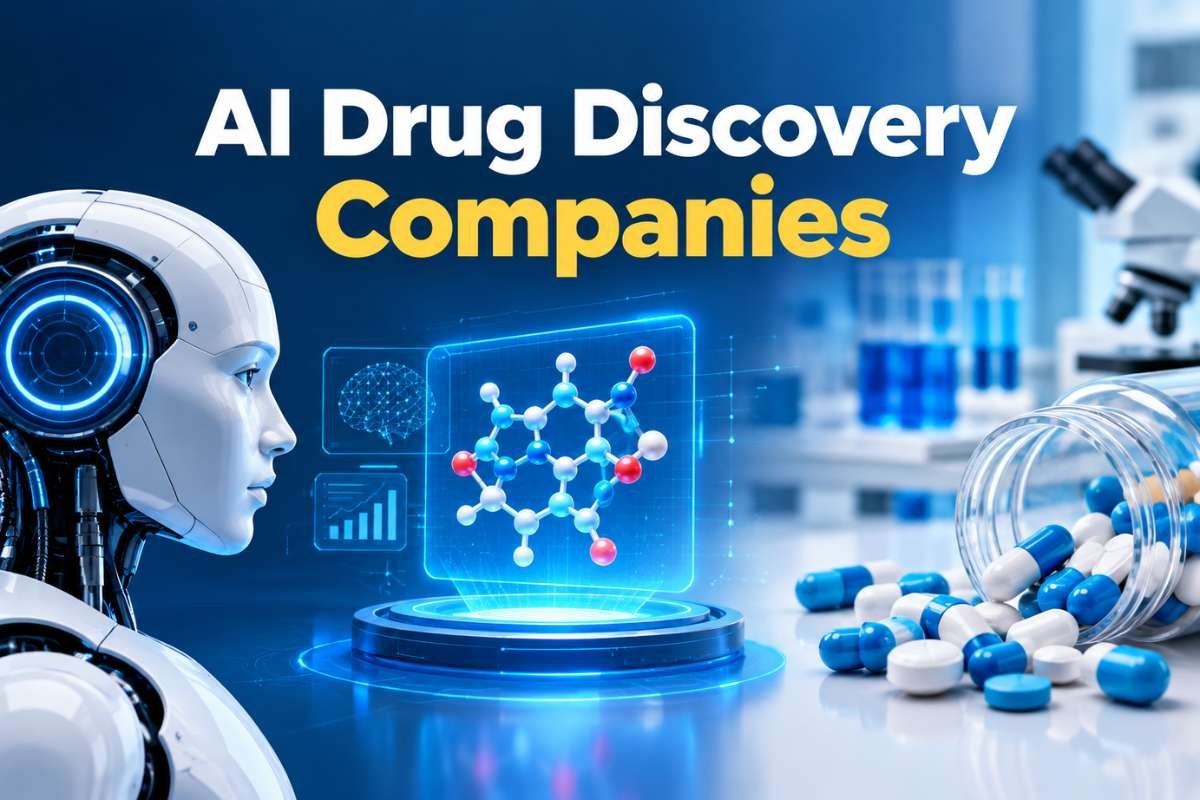
Drug R&D teams now use AI to study data, find targets, design drugs, and guide lab work. AI is moving from a side tool into core drug R&D. For biotech and pharma leaders, the key question is where AI can add value. The right platform must move beyond models and show value in real drug programs.
This guide reviews 10 AI drug discovery companies across drug design, protein design, biology, and data science. For leaders, platform fit matters as much as model quality. A clear business need can help teams review vendors and partners.
10 AI Drug Discovery Companies Pharma Leaders Should Track
The companies below are not ranked. Each one has a different focus, data set, and deal model. 57% of life sciences organizations already invest in AI for drug discovery. This list of companies can help with early vendor and partner reviews.
| Company | Core Strength | Clinical Stage/Proof | Pharma Partnerships | 2026 Signal |
| Isomorphic Labs | AI drug design | Preclinical | Novartis, Lilly | Expanded Novartis work |
| Insilico Medicine | End-to-end AI drug R&D | Phase III | Takeda and others | Rentosertib entered Phase III |
| Recursion | AI-based biology and chemistry | Five clinical programs | Sanofi, Roche/Genentech | More than $500M in partner payments |
| Generate | Protein design | Phase III | Roswell Park and others | $400M IPO |
| Xaira Therapeutics | AI and virtual cell research | Preclinical | Multiple partners | X-Cell launched |
| Absci | AI-based biological design | Phase I | Lilly and others | $100M financing and Phase I data |
| Owkin | Multimodal data and AI agents | Clinical programs | AstraZeneca, Sanofi, Servier | New 2026 pharma deals |
| insitro | Machine learning and biology | Preclinical and partnered work | Lilly and others | TherML launched |
| XtalPi | AI, robotics, and physics | Discovery partnerships | Global biopharma partner | $400M+ deal potential |
| Schrödinger | Physics-based tools and AI | Clinical-stage programs | BMS, Lilly | Bunsen deployment |
1. Isomorphic Labs
Isomorphic Labs grew from Google DeepMind’s AlphaFold work. It focuses on AI-based drug design, mainly for small molecules. It works with Novartis and Eli Lilly on new drugs.
Novartis expanded its deal in 2025. The change added up to three more research programs. The 2024 Lilly and Novartis deals had total potential value near $3 billion, excluding royalties.
Its work may suit teams studying hard drug targets. Its ties with large drug makers also give teams a clear partner model to review.
2. Insilico Medicine
Insilico uses Pharma.AI across drug R&D. Its tools cover target finding, drug design, and clinical work. Its lead drug, rentosertib, entered Phase III trials for idiopathic pulmonary fibrosis in July 2026.
The company dosed the first patient in September. It also signed a Takeda deal worth up to about $600 million in July 2026. Takeda will develop and commercialize selected drugs from the work.
Its key value is the link from AI-led discovery to human trials. This gives pharma teams a clear path to track.
3. Recursion
Among AI drug discovery companies, Recursion stands out for its integrated approach to biology, data, and drug design. Its main system is called Recursion OS. In 2026, the company reported five clinical-stage programs.
It also works with Sanofi and Roche/Genentech. Genentech has advanced a neuroscience target into joint early research. Recursion also reported more than $500 million in partner payments.
Its model may suit teams seeking one platform across biology and drug design. Its clinical and partner work also gives teams more proof to review.
4. Generate
Generate uses machine learning and lab work to design protein drugs. Its lead program, GB-0895, is an anti-TSLP antibody for severe asthma. It is now in Phase III studies.
Generate completed its U.S. IPO in February 2026. The offering raised $400 million before fees and expenses. The company also has other clinical programs in its pipeline.
Its main focus is new protein design. This may suit teams that need new proteins, not just drug screening.
Also Read: 2025’s Most Influential Medical Device Companies by Revenue & Reach
5. Xaira Therapeutics
Xaira Therapeutics uses AI across biology, drug design, and drug development. In March 2026, it launched X-Cell, a virtual cell model trained on billions of genomic data points.
The model aims to help researchers predict how cells respond to changes. Xaira also raised nearly $1 billion at launch in 2024.
For pharma teams, its work may support causal biology and cell models. The X-Cell launch is its clearest 2026 platform signal.
6. Absci
Absci uses generative AI to design biological drugs. Its work centers on antibodies and proteins. The platform can create leads for new or known targets.
In June 2026, Absci reported positive interim Phase I data for ABS-201. It also completed a $100 million offering, including a $40 million strategic investment from Eli Lilly.
Absci also lists partnerships with AstraZeneca, Merck, Almirall, Owkin, and other firms. Its focus may suit teams working on hard-to-drug targets and new biological designs.
7. Owkin
Owkin is one of the AI drug discovery companies that combines patient data with AI tools for drug R&D. Its K Pro platform uses multimodal data and AI agents for research work.
In 2026, Owkin announced K Pro deals with AstraZeneca, Sanofi, and Servier. These deals cover AI agents, data, and research work. It also has work with other drug firms.
For pharma leaders, Owkin may fit teams that use many types of health data. Its model can support work across research and drug development.
8. Insitro
Insitro uses machine learning, health data, and human genetics for drug R&D. In January 2026, it agreed to acquire CombinAbleAI.
It also launched TherML, a full-stack platform for drug design. The platform covers small molecules, oligonucleotides, antibodies, and other biologics.
Insitro also works with Lilly on drug research. Its broad model may suit teams working across more than one drug type.
Also Read: Who Leads Global Medicine? Here are the 24 Largest Pharmaceutical Companies in the World
9. XtalPi
XtalPi combines AI, robotics, and quantum physics for drug research. In June 2026, it announced a deal with an international biopharma firm.
The deal aims to develop an oral small molecule against a GPCR target. It has potential value above $400 million, including milestones and royalties. The work followed a pilot study that showed stronger hit rates.
Its model links computer-based drug design with lab work. This may suit R&D teams that need both.
10. Schrödinger
Schrödinger combines physics-based drug models with AI. It sells tools to pharma and biotech firms for drug research.
In August 2026, Bristol Myers Squibb agreed to deploy its Bunsen AI co-scientist in research. Bunsen can support research tasks and work with Schrödinger’s computational tools.
In January 2026, Schrödinger also partnered with Lilly to make TuneLab available through LiveDesign. This links AI models, physics-based methods, and experimental data in one workflow.
Its strength is the link between AI and established computer-based R&D tools.
What Should Pharma Leaders Compare Before a Partnership?
A review of AI drug discovery companies should start with one clear R&D need. Teams should then compare the platform, proof, data fit, and deal model.
Matt Truppo, Global Head of Computational & AI Strategy, R&D at Sanofi, says:
“AI offers the opportunity to better connect target identification, molecule design and clinical development, rather than treating them as separate steps.”
This suggests that pharma teams should look beyond model performance. They should ask how well AI drug discovery companies fit the wider R&D process and add value.
| Factor | Questions to ask |
| Biology | Can it help find and test drug targets? |
| Chemistry | Can it design new drugs or proteins? |
| Clinical proof | How many programs reached human trials? |
| Data fit | Can it use our data under our rules? |
| Workflow fit | Can it link with lab and clinical systems? |
| Deal structure | Is the deal a license, a joint work, or an asset deal? |
A target tool may not fix a chemistry problem. A drug design tool may not cover later drug work. Match each platform to one clear need and one clear result.
Also Read: Can AI Be Used in Healthcare? Here are 15 AI Healthcare Companies That are Changing the Sector
Conclusion
The AI drug discovery market covers target finding, drug design, protein work, data, and clinical research. For biotech and pharma leaders, compare AI drug discovery companies by proof, workflow fit, data needs, and deal terms.
These points can make vendor reviews more useful. The goal is not to pick one company for every need. Instead, teams can find the platform that fits each drug program, data set, and stage.
FAQs
1. What are AI drug discovery companies?
They are biotech and tech firms that use AI in drug R&D. Their tools can help find targets, design drugs, and support drug development.
2. How do pharma companies use AI in drug discovery?
Pharma teams use AI to study health data, find targets, design drugs, and test drug traits. AI can also support later drug development work.
3. Which drug types can AI support?
AI can support small molecules, antibodies, proteins, and oligonucleotides. It can also support work across more than one drug type.
4. What should pharma companies check before a deal?
Teams should check proof, clinical progress, data fit, workflow fit, and deal terms. They should also match the tool to a clear R&D need.
5. Can AI-designed drugs reach clinical trials?
Yes. AI drug discovery companies have helped create drug programs that reached human trials. Insilico’s rentosertib is one such example.