Shopping for vitamin D supplements can be confusing when some bottles say vitamin D and others specifically say D3. Here’s the short answer: vitamin D is the umbrella term, and D3 (cholecalciferol) is one of its two main forms, alongside D2 (ergocalciferol). That’s why the real comparison is D2 versus D3, not vitamin D versus D3. Research consistently shows D3 raises blood vitamin D levels more effectively than D2.
In this guide on Vitamin D vs. D3, you’ll learn where each form comes from, how well they work, how supplementation differs, and what to know about safety.
Vitamin D vs. D3: What’s the Difference?
Vitamin D is a category of nutrients, while vitamin D3 is one form of it. The other main form is vitamin D2. Both help the body absorb calcium, support bone mineralization, and maintain normal muscle function.
Vitamin D vs. D3
Vitamin D3, or cholecalciferol, is produced in the skin after UVB exposure and is also found in some animal-derived foods. Vitamin D2, or ergocalciferol, comes from certain fungi and UV-exposed mushrooms and is used in some fortified foods and supplements.
When considering vitamin D vs. D3, remember that both forms are processed first in the liver and then in the kidneys, where they are converted into the active form the body can use.
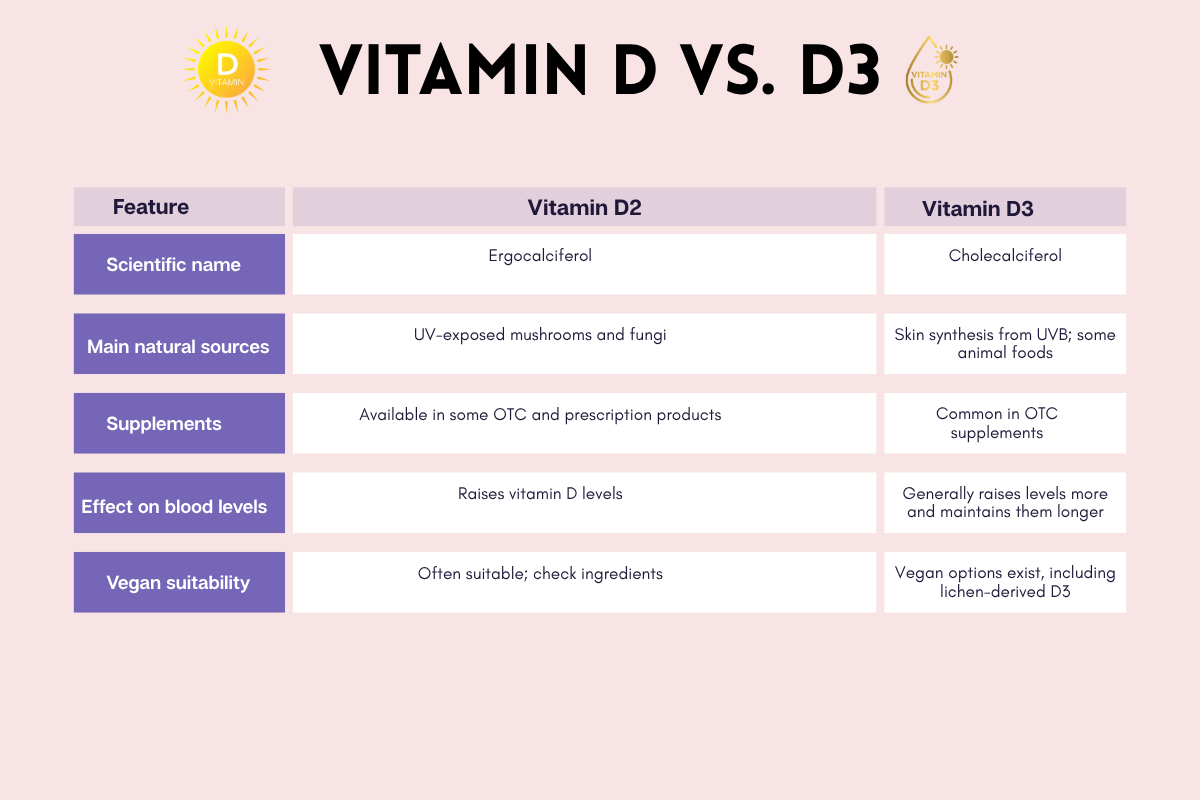
| Feature | Vitamin D2 | Vitamin D3 |
| Scientific name | Ergocalciferol | Cholecalciferol |
| Main natural sources | UV-exposed mushrooms and fungi | Skin synthesis from UVB; some animal foods |
| Supplements | Available in some OTC and prescription products | Common in OTC supplements |
| Effect on blood levels | Raises vitamin D levels | Generally raises levels more and maintains them longer |
| Vegan suitability | Often suitable; check ingredients | Vegan options exist, including lichen-derived D3 |
A bottle labeled simply “vitamin D” may contain either D2 or D3. Check the Supplement Facts panel for “ergocalciferol” (D2) or “cholecalciferol” (D3) to identify the actual form.
Also Read: Best Vitamin D Supplements: Avoid These Common Mistakes in 2026
Vitamin D2 vs. D3: Sources, Benefits and Effectiveness
Vitamin D2 and D3 both contribute to vitamin D status, calcium absorption, and bone health, but they differ in how effectively they raise blood levels. Vitamin D3 generally increases and maintains serum 25-hydroxyvitamin D levels more than vitamin D2, though this does not automatically mean it produces better long-term health outcomes for every person.
Sources and effectiveness
Fatty fish such as salmon, trout, tuna, and mackerel are among the best natural sources of vitamin D; egg yolks, beef liver, and cheese contain smaller amounts. UV-exposed mushrooms provide vitamin D2. Fortified foods, including some milks, plant-based drinks, cereals, and juices, may contain either form. Not every food naturally contains meaningful amounts of vitamin D.
Sunlight supports vitamin D3 production when UVB rays reach bare skin. The amount produced varies with season, latitude, time outdoors, age, sunscreen use, and skin pigmentation.
When comparing vitamin D vs. D3 in practice. D3 is often the more common supplemental choice because evidence shows it raises levels. It also sustains 25-hydroxyvitamin D levels more effectively. However, D2 remains a useful option where appropriate, particularly for people who prefer fungal-derived vitamin D or use a clinician-prescribed product.
Vegan options
Vegans can consider vitamin D2 or lichen-derived vitamin D3, depending on the product’s ingredients and certifications. If a clinician recommends supplementation, the right choice depends on dietary needs, availability, clinical context, and the prescribed plan.
Also Read: Vitamin C Rich Foods That Actually Work Better Than Supplements
Which Vitamin D Supplement Should You Choose?

The best vitamin D supplement is not necessarily the highest-dose product or the one with the strongest health claims. Choose a form, dose, and product that fits your diet, health needs, and total intake from all supplements.
Choose by situation
- Everyday supplement: Check whether it contains D2 or D3, the amount per serving, and the serving instructions. Do not assume a higher dose is better.
- Vegan diet: Look for vitamin D2 or vegan D3, often lichen-derived. Review other capsule ingredients as well.
- Low blood-test result: Ask a healthcare professional which form and dose are appropriate rather than self-prescribing a high-dose supplement.
- Already taking a multivitamin: Check its vitamin D amount before adding another product, because doses from all supplements count toward your daily intake.
- Taking medication or managing a condition: Ask your clinician or pharmacist about suitability and possible interactions; vitamin D can interact with some medicines.
When weighing Vitamin D vs. D3, D3 is a common choice for supplementation, but D2 can be appropriate depending on dietary preference, availability, and clinical advice.
Label-reading example
On a Supplement Facts panel, look for:
- Form: “Vitamin D3 (as cholecalciferol)” or “Vitamin D2 (as ergocalciferol).”
- Amount per serving: For example, “25 mcg (1,000 IU).”
- Your total daily intake: Add this to vitamin D from a multivitamin and any other supplements.
For adults aged 19 and older, NIH lists 100 mcg (4,000 IU) daily as the upper limit from food, beverages, and supplements combined.
How Much Vitamin D Do You Need, and Is It Safe?

In the United States, the recommended daily allowance for vitamin D is 600 IU (15 mcg) for people aged 1–70, including during pregnancy and lactation, and 800 IU (20 mcg) for adults over 70.
Testing and safe limits
The standard measure of vitamin D status is a blood test for 25-hydroxyvitamin D, or 25(OH) D. Routine testing is not recommended for every healthy adult, but a clinician may order it when risk factors, symptoms, or medical circumstances make it appropriate.
When choosing between vitamin D vs. D3, the dose matters as much as the form. For adults, 4,000 IU (100 mcg) per day is the U.S. tolerable upper intake level from food, drinks, and supplements combined. It is a safety ceiling, not a recommended target. A clinician may prescribe higher doses temporarily to treat a diagnosed deficiency.
Risks of excess
Taking too much supplemental vitamin D can cause toxicity and high blood calcium (hypercalcemia). Over time, this can damage the kidneys, soft tissues, and bones. Kidney stones and kidney injury are possible complications.
Do not start a high-dose vitamin D supplement without medical guidance, particularly if you have a health condition or take medication that may interact with it. For everyday use, aim to meet your individual needs safely rather than maximizing the dose.
Also Read: Tired All the Time? These Symptoms of Vitamin Deficiency May Explain Why
Conclusion:
The Vitamin D vs. D3 question has a simple answer: D3 is a form of vitamin D, so the real choice is between D2 and D3. D3 generally raises and maintains blood levels more effectively, while D2 remains a practical option for vegan diets or prescribed products. The best supplement is the one that fits your diet, health needs, and clinician’s advice, not the one with the biggest numbers on the bottle.
If you’re unsure where to start, talk with your healthcare provider about what suits you.
FAQ:
1. Is vitamin D the same as vitamin D3?
Vitamin D is the umbrella term for D2 and D3, while vitamin D3 is one specific form.
2. Can you take vitamin D and D3 together?
Since D3 is a form of vitamin D, taking both supplements may duplicate your dose, so check the labels before combining them.
3. Which is better for bone health, vitamin D vs. D3?
Both D2 and D3 support bone health by helping the body absorb calcium, and D3 generally raises vitamin D levels more effectively.
4. Can you get enough vitamin D3 from sunlight alone?
Sunlight can help your skin produce vitamin D3, but the amount varies with UVB exposure, season, skin pigmentation, and other factors.
5. Can you take vitamin D3 every day?
Daily vitamin D3 may be appropriate for some people, but the need and dose depend on age, dietary intake, and individual health factors.